

Electric Shower Installation in Liverpool & Birkenhead
Need a new electric shower installed or replacing an older unit?
Dan Electrician provides professional electric shower installation across Liverpool, Birkenhead and the Wirral, including new circuits, replacement showers, electrical testing and upgrades where the existing installation is not suitable.
Before installation, we check the existing supply, cable, protective devices and consumer unit so the new shower is matched properly to the electrical installation — rather than simply connecting a more powerful unit to an old circuit.
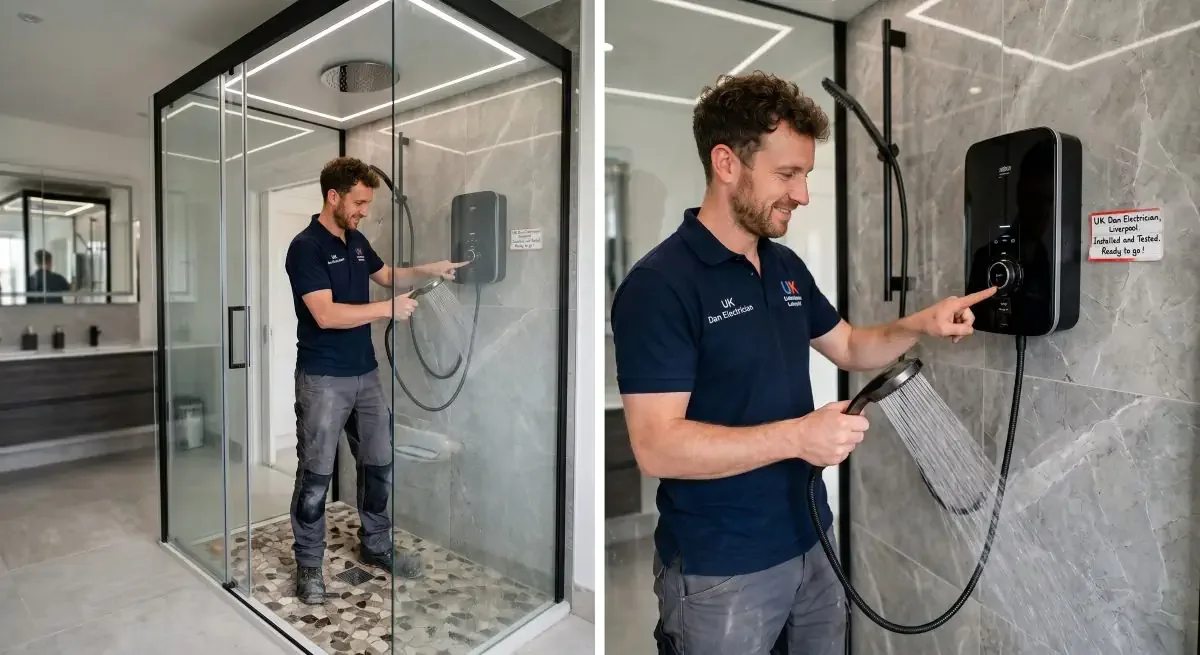
NICEIC Registered · Fully Insured
30+ Years’ Electrical Experience
Installation · Replacement · Testing & Certification
New Electric Shower Installation
Installing a new electric shower involves much more than fixing the unit to the bathroom wall.
Electric showers are high-demand electrical appliances, so the circuit needs to be designed around the shower rating, cable route, installation conditions and the existing electrical supply.
Before fitting a new shower, we can assess:
The proposed shower power rating
Existing consumer unit
Available electrical supply
Cable size and route
Existing protective devices
Earthing arrangements
Shower isolator or pull-cord position
Bathroom electrical zones
Whether a new dedicated circuit is required
Choosing the Shower Before the Electrical Work
If you have not yet bought the shower, it can be useful to check the electrical installation first.
A more powerful shower is not automatically the best option if the existing circuit or supply cannot support it without significant alterations.
We can assess the existing installation and help you understand what shower ratings are practical before you purchase the unit.
New Installation or Existing Bathroom?
Electric showers can be installed as part of:
Bathroom refurbishments
New shower rooms
Loft conversions
Replacement bathrooms
Rental property upgrades
Existing bathrooms without an electric shower
Where no suitable shower circuit already exists, a new cable may need to be installed from the consumer unit to the bathroom.
The route will depend on the construction of the property and the location of the consumer unit.
The shower should be selected to suit the electrical installation — not the other way around.
Checking the supply, cable and protective devices first can prevent unnecessary problems after the shower has already been purchased.
Replacing an Existing Electric Shower
Replacing an old electric shower can sometimes be straightforward, but it should never be assumed that a newer or more powerful shower can simply be connected to the existing circuit.
Before fitting the replacement, we check the shower rating, cable, protective device, isolator, consumer unit and condition of the existing circuit.
That is especially important when upgrading from an older lower-powered shower to a modern higher-powered model.
Can I Replace My Old Shower With a More Powerful One?
Possibly — but the existing electrical circuit needs to be checked first.
For example, a homeowner may want to replace an older 7.5 kW or 8.5 kW shower with a 9.5 kW or 10.8 kW model.
The new shower will place a greater demand on the circuit, so the existing cable and protective device may no longer be suitable.
The answer depends on more than the number printed on the cable. We also need to consider how the cable is installed, its route, surrounding insulation, circuit length and other installation conditions.
Never assume that because the old shower worked, the same circuit is suitable for a higher-powered replacement.
What We Check Before Reusing the Existing Circuit
Before connecting the new shower, we assess:
Existing shower power rating
New shower power rating
Cable size and installation method
Circuit protective device
RCD or RCBO protection
Consumer unit condition
Shower isolator or pull-cord switch
Earthing and bonding arrangements where relevant
Signs of overheating or damaged connections
Results of electrical testing
If the existing circuit is suitable, there is no reason to replace it unnecessarily.
If something needs upgrading, we can explain what needs changing and why before carrying out additional work.
Like-for-Like Shower Replacement
Replacing a shower with another unit of a similar electrical rating may require fewer alterations, provided the existing circuit is correctly designed and remains in satisfactory condition.
However, “like-for-like” does not mean the electrical installation should be ignored.
Older shower circuits can sometimes have loose connections, heat-damaged isolators or protective arrangements that need attention before the new unit is connected.
Shower Pull-Cord & Isolator Checks
The shower isolator carries a significant electrical load and is one of the areas worth checking carefully during replacement.
Signs of a problem can include:
discolouration, a burning smell, cracking, buzzing, excessive heat or a pull cord that no longer operates correctly.
Where an isolator shows signs of deterioration, it should be investigated rather than simply reconnecting the new shower to it.
What if the Existing Cable Is Too Small?
If the existing circuit is not suitable for the new shower rating, there are usually two sensible options:
Choose a shower that suits the existing circuit, provided the circuit itself tests satisfactorily, or upgrade the shower circuit so it is correctly designed for the higher electrical load.
We will not recommend rewiring the shower circuit simply because a new shower is being fitted. The decision should come from the shower rating, circuit design and test results.
Bought the Shower Already?
If you have already purchased a replacement shower, send us the make, model and kW rating.
If possible, also send a photo of:
The existing shower
Consumer unit
Shower circuit breaker
Pull-cord or isolator
That gives us useful information before attending, although the final decision on circuit suitability needs to be based on the installation itself.
Upgrading the shower does not automatically mean upgrading the electrical circuit — but a higher-powered shower should never be connected until the existing circuit has been checked and confirmed suitable.
Can I Upgrade to a More Powerful Electric Shower?
Yes, in many properties you can upgrade to a more powerful electric shower — but the existing shower circuit must be checked first.
Moving from an 8.5 kW shower to a 9.5 kW or 10.8 kW model increases the electrical demand. That can affect the suitability of the existing cable, circuit breaker, isolator and consumer unit.
For an instantaneous electric shower, the circuit is designed to carry the shower's full rated load rather than relying on electrical diversity. The IET specifically confirms this principle for shower circuit design.
More kW Means More Electrical Demand
The kW rating tells you how much electrical power the shower can use.
As the rating increases, so does the current required from the circuit.
For example, upgrading from:
8.5 kW → 9.5 kW → 10.8 kW
may provide the performance you want, but it can also mean the existing shower circuit needs reassessing.
That is why we recommend checking the electrical installation before purchasing the highest-powered shower available.
Does a 10.8 kW Shower Always Need a New Cable?
Not automatically.
Some existing shower circuits may already have been designed with sufficient capacity for the new shower.
Others may require alteration or a new circuit.
We determine that from the actual installation rather than assuming that every 10.8 kW shower needs the same cable arrangement.
Is My Existing Shower Cable Big Enough?
Cable size is important, but the number printed on the cable is only part of the assessment.
Its safe current-carrying capacity can also depend on:
How the cable is installed
Whether it passes through thermal insulation
Cable length
Ambient conditions
Whether cables are grouped together
The protective device being used
Voltage drop
Condition of existing connections
How the circuit was originally designed
So a cable that may be suitable in one property is not automatically suitable in another simply because it has the same conductor size.
Will I Need a New Consumer Unit?
Again, not necessarily.
We check whether the existing consumer unit can accommodate the shower circuit and whether the required protection can be provided correctly.
If the board is suitable, we will not recommend replacing it simply because you are upgrading the shower.
If alterations are genuinely required, we will explain what is needed and why.
What About the Circuit Breaker?
The protective device also has to suit the circuit and shower load.
Installing a larger circuit breaker is not a shortcut for fitting a more powerful shower.
The cable, protective device and connected equipment need to be considered together as part of the circuit design.
If the existing cable cannot safely support the required load, simply increasing the breaker rating is not an acceptable solution.
What if My Existing Circuit Cannot Take the Bigger Shower?
There are usually two practical choices.
Option 1 — Choose a Lower-Powered Shower
If the existing circuit is satisfactory but does not have sufficient capacity for the proposed higher-powered unit, choosing a suitable lower-rated shower may avoid major electrical alterations.
Option 2 — Upgrade the Shower Circuit
If you specifically want the higher-powered shower, a new or upgraded dedicated circuit may be required.
That can involve a new cable route, suitable circuit protection, isolator arrangements and electrical testing.
Which option makes sense depends on the property and what you want from the shower.
Check Before You Buy
If you are considering replacing an existing shower, send us the make, model and kW rating of the old shower and the model you are thinking of buying.
A photo of the consumer unit and existing shower isolator can also be useful for an initial assessment.
We can then establish whether the proposed upgrade looks straightforward or whether the existing circuit needs closer inspection.
Don't choose a 9.5 kW or 10.8 kW shower simply because it is more powerful. Check that the electrical installation can support it first — you may save yourself the cost and hassle of buying a shower that cannot be connected to the existing circuit.
Cable Size & Electrical Supply for an Electric Shower
Electric showers can place one of the highest electrical demands on a domestic installation.
That makes correct cable selection especially important.
The cable must be capable of carrying the full rated load of the shower. The IET specifically confirms that diversity should not be applied when sizing a cable for an instantaneous electric shower.
What Cable Size Does an Electric Shower Need?
There is no single cable size that can safely be recommended from the shower's kW rating alone.
The correct size depends on several factors, including:
Shower power rating
Cable installation method
Length of the circuit
Ambient temperature
Thermal insulation around the cable
Grouping with other cables
Voltage drop
Protective device
Condition and type of the existing wiring
This is why we avoid simplistic rules such as:
“8.5 kW always needs this cable”
or
“10.8 kW always needs that cable.”
BS 7671 cable selection is based on the actual installation conditions, and factors such as thermal insulation can significantly reduce a cable's current-carrying capacity.
Shower kW → Cable Route → Installation Method → Protective Device → Final Cable Design
What About Cable Length?
Longer cable runs can also affect circuit design.
The electrician needs to consider issues such as:
Voltage drop
Earth fault loop impedance
Protective device operation
Cable current-carrying capacity
Cable length is therefore part of the calculation rather than simply choosing a conductor size from the shower rating.
Why Does Thermal Insulation Matter?
Modern homes often have insulation in lofts, walls and floor spaces.
If a shower cable passes through or is surrounded by thermal insulation, it may not be able to lose heat as effectively.
That can reduce the amount of current the cable can safely carry.
So two apparently identical cables can have different usable capacities depending on how they are installed.
What if the Cable Runs Through the Loft?
A loft route can be perfectly acceptable, but the way the cable passes through insulation needs particular attention.
A cable clipped in a ventilated position can behave very differently from the same cable buried beneath thick loft insulation.
The route needs to be inspected before its capacity is confirmed.
Can I Reuse the Existing Cable?
Often, yes.
If the existing cable is correctly sized for the proposed shower, has been installed appropriately and passes electrical testing, there may be no reason to replace it.
However, if you are increasing the shower rating, the circuit needs to be reassessed for the new load.
Does an Electric Shower Need Its Own Circuit?
Normally, yes.
An electric shower is a high-demand appliance and is generally supplied by a dedicated circuit from the consumer unit rather than sharing an ordinary socket or lighting circuit.
Is the House Supply Large Enough?
We also consider the electrical installation as a whole.
A powerful electric shower may operate at the same time as:
Electric cooker
Induction hob
Immersion heater
EV charger
Electric heating
Other significant household loads
The existing installation and distributor's equipment should be assessed where alterations increase electrical demand. The IET highlights this requirement when existing installations are altered.
Cable size cannot be chosen safely from the shower's kW rating alone. The shower, cable route, installation method and protective device all need to be considered together.
Consumer Unit, RCD & RCBO Protection for an Electric Shower
The consumer unit is an important part of any electric shower installation.
Before connecting a new shower, we check whether the existing board can safely accommodate the circuit and whether the required protective devices are already in place.
A new electric shower does not automatically mean you need a new consumer unit.
Does an Electric Shower Need RCD Protection?
Bathrooms are treated as special locations under BS 7671.
Current wiring requirements include additional RCD protection for circuits serving locations containing a bath or shower.
For a new or altered shower circuit, we assess how this protection should be provided within the existing installation.
When Might Additional Work Be Needed?
Additional work may be recommended where we find issues such as:
No suitable way to provide the required circuit protection
Damaged or deteriorated equipment
Insufficient capacity for the proposed circuit
Defects identified during testing
Unsuitable existing shower protection
Other issues affecting safe alteration of the installation
Any recommendation should come from inspection, testing and circuit design — not from the age or appearance of the consumer unit alone.
RCD or RCBO?
Depending on the consumer unit, shower protection may be provided using an RCD arrangement or an individual RCBO.
An RCBO combines:
Overcurrent protection
Short-circuit protection
Residual-current protection
into one device for the individual circuit.
This can be useful because a fault on the shower circuit does not necessarily disconnect unrelated circuits sharing the same RCD.
What About Older Fuse Boxes?
An older fuse box does not automatically mean an electric shower cannot be installed.
However, the existing installation must be assessed before a high-demand new or replacement circuit is connected.
Sometimes an upgrade is sensible; sometimes more limited alterations are sufficient.
The decision should be based on the actual installation.
Do I Need a Consumer Unit Upgrade?
Not necessarily.
If the existing consumer unit:
Is in satisfactory condition
Has suitable capacity
Can provide the required protection
Is compatible with the proposed circuit
Tests satisfactorily
then the shower installation may be possible without replacing the whole board.
We do not recommend a consumer unit replacement simply because the board is older.
Earthing & Bonding
The condition of the earthing arrangements also forms part of the assessment.
BS 7671 includes particular requirements for locations containing a bath or shower, including conditions relating to protective bonding and RCD protection.
Where the existing installation is being altered, we check that the earthing and relevant protective measures are suitable for the proposed work.
Installing an electric shower does not automatically mean replacing the consumer unit. We assess the existing board first and only recommend additional work where the installation actually requires it.
What Happens During an Electric Shower Installation?
Every property is slightly different, but a professional electric shower installation follows a clear process.
The first step is understanding what is already there before deciding whether the existing circuit can be reused or whether additional electrical work is required.
1. Check the Existing Electrical Installation
We start by assessing the existing shower circuit or, for a completely new installation, the electrical supply available for a new circuit.
This can include checking:
Consumer unit
Shower circuit
Cable size and route
Protective device
RCD or RCBO protection
Earthing arrangements
Existing shower isolator
Proposed shower rating
4. Install or Prepare the Shower Circuit
Where a new dedicated circuit is required, the cable and protective equipment are installed according to the circuit design.
Where an existing circuit is being reused, it is inspected and tested before connection to the new equipment.
2. Confirm the New Shower Rating
We check the electrical rating of the shower being installed.
If it is replacing an existing unit, we compare the old and new ratings to establish whether the existing circuit remains suitable.
A jump from an older lower-powered shower to a more powerful model should never be treated automatically as a like-for-like replacement.
5. Check the Shower Isolator
The existing isolator is checked for suitability and condition.
If it shows evidence of overheating, damage or unsuitable connections, this needs addressing before the new shower is put into service.
7. Inspect & Test the Electrical Work
The circuit is then inspected and electrically tested.
The exact tests depend on the work carried out, but the purpose is to verify that the circuit and protective measures operate as intended.
3. Agree the Cable Route
For a new circuit or circuit upgrade, we agree how the cable will travel between the consumer unit and bathroom.
Depending on the property, this might involve:
Loft space
Floor voids
Accessible service routes
Internal containment
Surface-mounted containment where appropriate
Other practical routes agreed before work begins
We aim to avoid unnecessary disturbance while still installing the circuit correctly.
6. Connect the Electric Shower
Once the electrical supply has been confirmed suitable, the shower can be connected in accordance with the manufacturer's instructions and the requirements of the installation.
8. Certification & Handover
The appropriate electrical documentation is completed for the work undertaken.
Where the installation is notifiable under Part P of the Building Regulations in England, the required Building Regulations notification must also be dealt with through the appropriate route. A new circuit and additions or alterations within the defined special location around a bath or shower are among the categories covered by Part P notification requirements.
The important part happens before the new shower is switched on: confirming that the circuit, cable, protection and isolator are suitable for the shower being installed.
Electric Shower Testing & Certification
Electrical testing is an important part of installing or altering an electric shower circuit.
The shower may look perfectly finished on the wall, but the electrical installation also needs to be checked to confirm that the circuit and its protective measures are suitable for service.
What Is Tested?
Depending on the work carried out, inspection and testing can include checks relating to:
Protective conductor continuity
Insulation resistance
Polarity
Earthing arrangements
Earth fault loop impedance
RCD or RCBO operation
Protective device suitability
Connections and terminations
Functional operation
General condition of the new or altered circuit
The exact testing depends on the installation rather than using the same checklist blindly for every shower replacement.
Will I Receive an Electrical Certificate?
Where a new shower circuit is installed, the work should be inspected, tested and appropriately certified.
A new circuit would normally be documented with an Electrical Installation Certificate (EIC).
For smaller additions or alterations to an existing circuit, different electrical certification may be appropriate depending on exactly what work has been carried out.
Approved Document P specifically covers design, installation, inspection, testing and provision of information for electrical work in dwellings.
Is Electric Shower Work Notifiable Under Part P?
Some shower work is.
In England, installing a new electrical circuit is notifiable work. Additions or alterations to an existing circuit within the defined special location around a bath or shower are also included within the Part P notification requirements.
Government guidance also identifies new circuits and electrical alterations around baths and showers as examples of work that may need Building Regulations notification.
Not every straightforward repair or equipment replacement is automatically notifiable, so the requirement depends on the work actually carried out.
What About a Simple Shower Replacement?
Replacing an existing shower unit does not automatically mean the whole electrical installation needs upgrading.
However, the existing circuit still needs to be suitable for the replacement equipment.
If the new shower has a different electrical rating or alterations are required to the circuit, those changes need to be assessed accordingly.
Electrical Certificate vs Building Regulations Certificate
These are related, but they are not the same document.
An electrical certificate records the electrical installation work and the results of the required inspection and testing.
Where the work is notifiable under Part P, there is also a separate Building Regulations compliance process. A registered Competent Person can self-certify qualifying work through their scheme rather than the homeowner making a separate Building Control application.
Why Keep Your Certificates?
Keep electrical documentation with the records for the property.
It provides useful information about what work was carried out and can help with future electrical alterations, inspections or property paperwork.
A professional shower installation should finish with appropriate testing and documentation — not simply with confirmation that the shower turns on.
How Much Does Electric Shower Installation Cost?
As a general guide:
Replacing an existing shower (on a suitable existing circuit) — from £150
New standard 32A shower circuit installation — from £450
Shower isolator / pull-cord switch replacement — from £80
These are starting prices for straightforward jobs. The final cost depends on the shower's power rating, the cable route, and whether the existing circuit, consumer unit or protective devices need upgrading.
What Affects the Cost?
The main factors include:
Whether it is a new installation or replacement
Shower power rating
Existing cable size and condition
Distance from the consumer unit
Cable route through the property
Existing circuit protection
RCD or RCBO requirements
Condition of the shower isolator
Whether a new dedicated circuit is required
Access to lofts, floors or service routes
Electrical testing and certification
Any additional electrical defects found during inspection
Installing a Completely New Electric Shower
Where the property does not already have a dedicated shower circuit, the installation can involve considerably more work.
A new installation may require:
New dedicated cable from the consumer unit
Suitable circuit protection
Shower isolator
Routing through floors, walls or loft spaces
Electrical testing
Certification
Building Regulations notification where applicable
The cable route is often one of the biggest factors affecting labour and installation complexity.
Does a New Consumer Unit Increase the Cost?
Yes, but a consumer unit replacement should only be considered where it is genuinely necessary.
If the existing board can safely accommodate the shower circuit and provide the required protection, there may be no reason to replace it.
Sometimes a more limited alteration may be possible instead.
Replacing an Existing Electric Shower
If the new shower has a similar electrical rating and the existing circuit is suitable, replacement can often be relatively straightforward.
We still check the circuit, isolator and protective devices before reconnecting the new unit.
A simple replacement should not automatically turn into a full circuit upgrade.
Upgrading to a More Powerful Shower
Costs can increase if you move from an older lower-powered shower to a higher-rated model.
For example, changing from an 8.5 kW shower to a 10.8 kW model may require the existing circuit to be reassessed.
If the cable, protective device or isolator is not suitable for the higher load, additional electrical work may be required.
This is why it is worth checking before buying the shower.
What About a Burnt Pull-Cord or Damaged Isolator?
If the shower isolator is damaged or shows signs of overheating, this may need to be repaired or replaced as part of the work.
We also check the associated cable and terminations because simply fitting a new switch without finding the cause of the damage may not solve the problem.
Shower Supplied by You or Supplied as Part of the Job?
If you already have the shower, send us:
Make
Model
kW rating
Photo of the existing shower
Photo of the consumer unit if possible
This helps us understand what is likely to be required.
If you have not bought the shower yet, it can be better to check the existing circuit first — particularly if you are considering a higher-powered model.
Clear Quote Before Work Starts
A proper quotation should make clear what is included.
Depending on the job, this may cover:
Labour
Cable and containment
Protective devices
Shower isolator
Electrical alterations
Testing
Certification
Building Regulations notification where applicable
If additional work is needed because the existing installation is unsuitable, we explain the reason before proceeding.
The cheapest-looking shower installation is not always the cheapest overall. Checking the circuit before buying the shower can prevent unexpected costs caused by an unsuitable cable, isolator or consumer unit arrangement.
Electric Shower Installation Across Liverpool, Birkenhead & the Wirral
Dan Electrician provides electric shower installation, replacement and electrical fault finding across Liverpool, Birkenhead and the wider Wirral.
Whether you are replacing an old shower, fitting a new unit during a bathroom refurbishment or upgrading to a more powerful model, we can assess the existing electrical installation and explain what work is actually required.
Electric Shower Installation in Liverpool
We provide electric shower installation across Liverpool for homeowners, landlords and suitable rental properties.
Depending on the job, the work can include:
New electric shower installation
Replacement of an existing shower
New dedicated shower circuit
Cable upgrades where required
RCD or RCBO protection
Shower isolator replacement
Electrical testing and certification
Fault finding for tripping or overheating shower circuits
Where the existing circuit is suitable, we can reuse it rather than recommending unnecessary electrical alterations.
Shower Replacement for Landlords
Electric shower faults can quickly become inconvenient in rental properties.
We provide replacement and electrical assessment for landlords across Liverpool, Birkenhead and the Wirral, including investigation of:
Tripping shower circuits
Damaged pull-cord switches
Burnt isolators
Failed shower units
Unsuitable replacement shower ratings
Electrical defects found during installation
Where additional work is required, we explain the issue clearly before proceeding.
Electric Shower Installation in Birkenhead
Dan Electrician is based in Birkenhead and provides electric shower work throughout the local area.
We can assess the existing shower circuit, consumer unit, cable and isolator before installing the replacement unit.
If you are thinking about upgrading to a higher-powered shower, it is worth checking the existing circuit before buying the new unit.
Bathroom Refurbishments & New Shower Rooms
If you are planning a bathroom refurbishment, it is useful to consider the shower electrical supply before the room is finished.
A new electric shower circuit may require access through:
Floors
Walls
Loft spaces
Service voids
Existing cable routes
Planning the electrical work early can make the final installation neater and reduce unnecessary disruption later.
Electric Shower Installation Across the Wirral
Coverage extends across the Wirral, including areas such as:
Prenton
Oxton
Bebington
Wallasey
Upton
Bromborough
Heswall
West Kirby
Hoylake
We work on both straightforward shower replacements and more involved installations requiring a new dedicated electrical circuit.
Already Bought a New Shower?
If you already have the replacement shower, send us:
Make and model
kW rating
Your postcode
Photo of the existing shower
Photo of the consumer unit
Photo of the shower pull-cord or isolator if possible
This gives us useful information before attending and helps establish whether the existing circuit is likely to be suitable.
From straightforward shower replacements to completely new dedicated circuits, we assess the existing installation first and only recommend additional electrical work where it is actually required.
Electric Shower Installation FAQs
-
It depends on whether the job is a straightforward replacement or a completely new installation. Replacing an existing shower on a suitable circuit can be relatively straightforward. A new installation requiring a dedicated cable from the consumer unit, a new isolator and additional circuit protection will usually take longer. The cable route and accessibility of the existing installation can make a significant difference.
-
Yes. We can replace an existing electric shower after checking that the electrical circuit, cable, protective device and isolator are suitable for the replacement unit. If the new shower has a higher kW rating than the old one, the circuit needs to be reassessed before connection.
-
Possibly, but do not assume the existing circuit is suitable. A higher-powered shower places greater demand on the electrical circuit. The cable, installation method, protective device, isolator and consumer unit all need to be considered. If you are planning an upgrade, it is better to check the circuit before purchasing the shower.
-
There is no single cable size that can be selected safely from the shower's kW rating alone. Cable design also depends on factors such as: - Installation method - Cable length - Thermal insulation - Grouping with other cables - Protective device - Voltage drop - Existing installation conditions Two properties using the same shower can therefore require different circuit arrangements.
-
Normally, yes. An electric shower is a high-demand appliance and is generally supplied by a dedicated circuit from the consumer unit rather than sharing an ordinary socket or lighting circuit.
-
Modern shower installations require appropriate additional protection. Depending on the consumer unit and circuit arrangement, this may be provided by an RCD or an individual RCBO. We assess the existing installation before deciding what protection is appropriate rather than automatically recommending a new consumer unit
-
Not automatically. If the existing consumer unit is in satisfactory condition, has suitable capacity and can provide the required protection, the shower may be installed without replacing the whole board. Additional work should only be recommended where inspection, testing or circuit design shows it is actually required.
-
A tripping shower can have several possible causes, including: - Fault within the shower - Earth leakage - Damaged wiring - Loose or overheated connections - Faulty isolator - Protective device issue - Circuit fault Repeatedly resetting the breaker, RCD or RCBO without investigating the cause is not a solution. If the shower continues to trip, stop using it and have the circuit checked.
-
Heat around a shower isolator can be caused by problems such as loose connections, deteriorated terminals or damaged equipment. Signs that need investigation include: - Burning smell - Discolouration - Melted plastic - Buzzing or crackling - Excessive heat A damaged pull-cord should not simply be replaced without checking the associated wiring and connections.
-
Yes, where the rest of the installation is satisfactory. We can replace a faulty shower isolator while also checking the cable connections and surrounding wiring for evidence of overheating or damage.
-
Yes, provided the shower is suitable for the electrical installation. Before attending, it helps if you send: - Shower make and model - kW rating - Photo of the existing shower - Photo of the consumer unit - Photo of the existing pull-cord or isolator If you are replacing an existing shower, the rating of the old unit is also useful.
-
If you are replacing a shower with a similar model and rating, that may be straightforward. However, if you want to upgrade to a more powerful shower, we recommend checking the existing circuit first. This can prevent you from buying a unit that requires electrical alterations you were not expecting.
-
Yes. A completely new electric shower installation will normally require a dedicated circuit from the consumer unit. The cable route, circuit protection, isolator position and bathroom installation conditions all need to be considered before work starts.
-
Yes — and planning the electrical work early is usually much easier. Ideally, the shower position and electrical requirements should be considered before walls, ceilings and floors are completely finished. This can make the cable route neater and reduce unnecessary disturbance later.
-
Yes. New or altered electrical work is inspected and tested as appropriate before being put into service. The purpose is to verify the circuit, protective devices and electrical safety measures rather than simply checking that the shower switches on.
-
Where electrical installation work requires certification, the appropriate documentation is provided following satisfactory inspection and testing. For a new dedicated circuit, this would normally include an Electrical Installation Certificate. Building Regulations notification is a separate requirement where the work is notifiable.
-
Yes. Dan Electrician provides electric shower installation, replacement and fault finding for landlords across Liverpool, Birkenhead and the Wirral. We can investigate shower faults, damaged isolators, tripping circuits and replacement units before explaining what work is required.
-
Call Dan on 07400 238767 or send a quote request. For a quicker initial assessment, include: - Your postcode - New shower make and model - Shower kW rating - Existing shower rating if known - Photo of the consumer unit - Photo of the existing shower - Photo of the pull-cord or isolator You don't need to identify the cable size or protective device yourself — we can assess the electrical details.
Not sure whether the shower you want will work with your existing circuit? Check before you buy. We can assess the installation and explain the options without recommending unnecessary upgrades.
Helpful Electrical Guides
If you are planning an electric shower installation, replacing an older unit or trying to understand a fault, these guides may help:
Why Does My RCD Keep Tripping?
If the shower or another circuit keeps tripping the RCD, the cause should be investigated rather than repeatedly resetting the device.
RCD vs RCBO
Not sure what the difference is between an RCD and an RCBO? This guide explains how each device works and why RCBO protection is commonly used for individual circuits.
READ: RCD VS RCBO
Consumer Unit Replacement
If your existing board cannot provide suitable protection for the new shower circuit, a consumer unit upgrade may sometimes be recommended. We assess the existing installation first and only recommend replacement where it is actually justified.
Electrical Fault Finding
A shower that trips, cuts out, overheats or behaves intermittently may need proper electrical testing before any replacement equipment is fitted.
Need an Electric Shower Installed or Replaced?
Whether you are fitting a completely new electric shower, replacing an older unit or upgrading to a higher-powered model, Dan Electrician can assess the existing electrical installation and explain what is required before the work starts.
We provide electric shower installation across Liverpool, Birkenhead and the Wirral, including: - New electric shower circuits - Replacement shower installation - Higher-powered shower upgrades - Shower pull-cord and isolator replacement - RCD and RCBO protection - Electrical fault finding - Testing and certification - Consumer unit alterations where genuinely required
If you already have the new shower, send us the make, model and kW rating together with a photo of the consumer unit if possible. If you have not bought the shower yet, we can check the existing circuit first so you know what rating is practical for the property.
Get an Electric Shower Installation Quote Call Dan on 07400 238767 or send us a message with the details of the job.
NICEIC Registered ·
Fully Insured 30+ Years’ Electrical Experience
Liverpool · Birkenhead · Wirral
Check the circuit before you buy the shower. A quick electrical assessment can prevent unexpected costs and make sure the new unit is matched properly to the installation.