

Socket Installation in Liverpool & Birkenhead
Need more plug sockets, replacing damaged accessories or upgrading older fittings?
Dan Electrician provides professional socket installation across Liverpool, Birkenhead and the Wirral, including additional sockets, replacement sockets, USB and USB-C outlets, outdoor sockets and socket fault finding.
Before adding or replacing accessories, we check the existing circuit and installation so the new socket is connected to a suitable electrical supply and properly tested afterwards.
NICEIC Registered · Fully Insured
30+ Years’ Electrical Experience
Additional Sockets · Replacements · Testing & Certification
Additional Socket Installation
Modern homes often need far more socket outlets than they were originally designed with.
Extra sockets can reduce reliance on extension leads and make rooms more practical for everyday use, especially where appliances, televisions, computers and chargers have increased over time.
We install additional sockets in areas such as:
Living rooms
Bedrooms
Kitchens
Home offices
Utility rooms
Garages
Hallways
Extensions
Rental properties
Small commercial premises
Where Should New Sockets Be Installed?
The best socket position depends on how the room will actually be used.
Before installation, it is worth considering:
Furniture positions
Television location
Bedside equipment
Desks and computers
Kitchen appliances
Charging points
Vacuum cleaner access
Future room layout
Planning the socket positions properly can avoid fitting extensions or trailing leads later.
Can You Add a Socket to an Existing Circuit?
Often, yes.
If the existing circuit is suitable, an additional socket can usually be added without installing a completely new circuit.
Before extending the circuit, we consider:
Existing circuit type
Cable condition
Protective device
RCD or RCBO protection
Existing loading
Earthing arrangements
Socket location
Electrical test results
If the existing circuit is satisfactory, there is no reason to carry out unnecessary rewiring.
Read more about House Rewire
Single or Double Sockets?
In most domestic rooms, double sockets are usually more practical than single outlets.
However, the best option depends on the position and intended use.
Some locations may suit:
Standard double sockets
Single appliance outlets
Switched fused connection units
USB or USB-C sockets
Outdoor sockets
Dedicated appliance connections
The accessory should suit the job rather than using the same fitting everywhere.
Surface-Mounted or Flush Sockets?
New sockets can sometimes be installed flush into the wall or surface-mounted depending on the property and cable route.
A flush installation can provide a neater appearance, but it may involve chasing the wall and making good afterwards.
Surface-mounted accessories and containment can be useful where avoiding wall damage is more important than having the wiring completely hidden.
We can discuss the options before work starts.
Adding Sockets During Renovation
If you are renovating a room, planning the electrical work early can make the installation much easier.
Sockets can be positioned before decorating, plastering or fitting furniture, allowing cable routes to be planned more neatly.
This is especially useful for kitchens, home offices and major refurbishments.
Adding a socket should be based on the condition and design of the existing circuit — not simply on finding the nearest cable and connecting to it.
Replacing Old, Damaged or Burnt Sockets
A damaged socket should not be ignored simply because it still works.
Cracked faceplates, loose switches, heat marks, buzzing or a burning smell can indicate a problem with the accessory, the cable connection behind it or the circuit supplying it.
We can replace faulty sockets and check the surrounding wiring so the cause of the damage is not missed.
Signs a Socket Needs Checking
Arrange an electrical inspection if you notice:
Cracked or broken faceplate
Loose socket on the wall
Plug not fitting securely
Switches becoming stiff or unreliable
Brown or black discolouration
Burning smell
Buzzing or crackling
Socket becoming unusually warm
Visible melting or heat damage
Intermittent power
If there is severe overheating, smoke or obvious burning, stop using the socket and isolate the circuit if it is safe to do so.
Why Do Sockets Overheat?
The socket itself may be faulty, but overheating can also be caused by:
Loose electrical connections
Damaged conductor ends
Poor previous terminations
Worn socket contacts
High-resistance connections
Faulty plugs or appliances
Deterioration of the accessory
Problems elsewhere on the circuit
That is why simply fitting a new faceplate is not always enough.
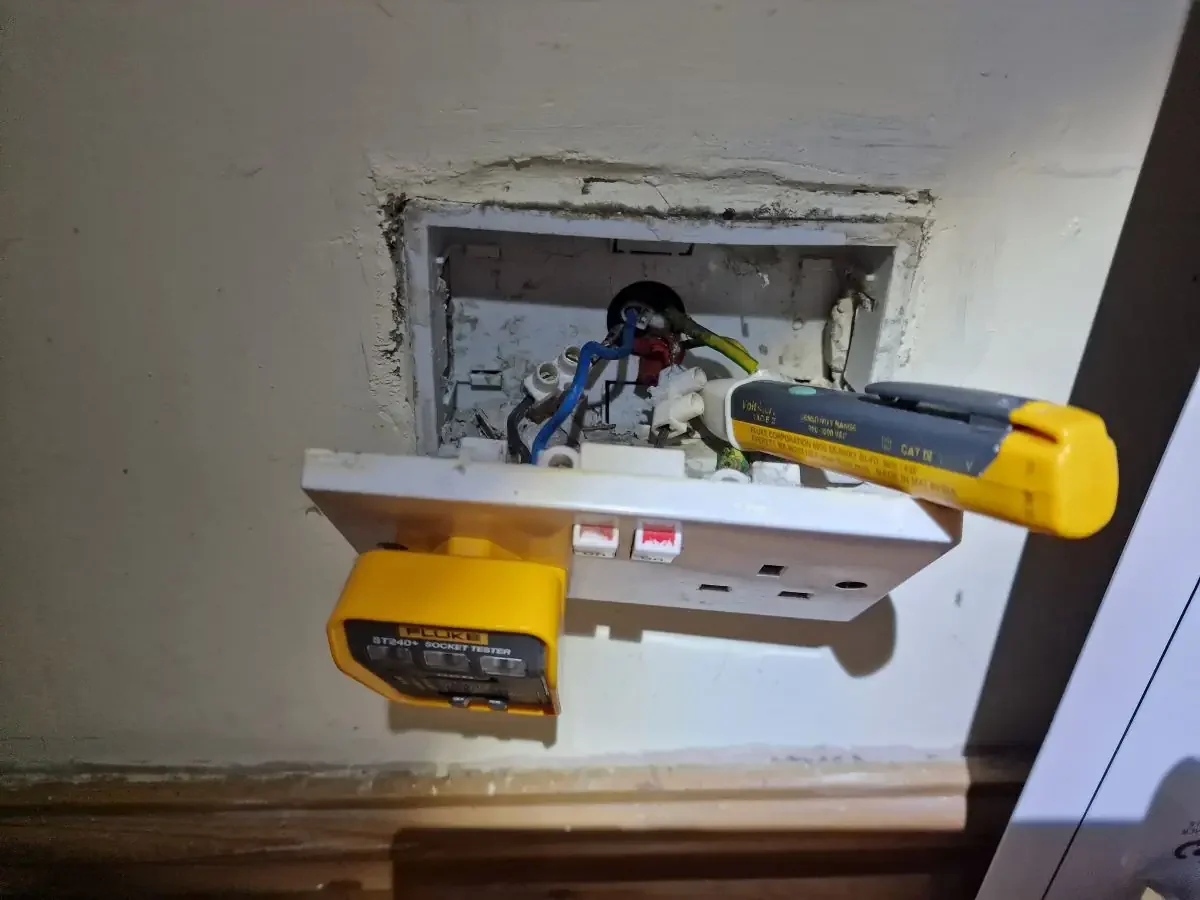
Can You Replace Just the Socket?
Often, yes.
If the cable and circuit are in satisfactory condition, replacing the damaged accessory may be all that is required.
Where we find heat damage behind the socket, we also check whether the cable ends, back box or connections need attention before the new fitting is installed.
Socket Loose in the Wall
A socket that moves when a plug is inserted can damage connections over time.
The cause may be:
Loose fixing screws
Damaged back box
Poor wall fixing
Deteriorated accessory
Previous installation damage
The socket should be secured properly rather than left to move repeatedly.
Burnt Socket — Do I Need Rewiring?
Not automatically.
One burnt socket does not mean the whole property needs rewiring.
The important thing is to determine why the damage occurred and whether the problem is local to that point or part of a wider circuit issue.
If the rest of the circuit tests satisfactorily, the repair can usually remain proportionate to the fault found.
Buzzing or Crackling Socket
Buzzing, crackling or arcing sounds are not normal.
These symptoms can indicate a poor connection or deteriorated contact and should be investigated before the socket continues to be used.
Socket Works Intermittently
A socket that cuts in and out can be caused by a loose connection, damaged accessory or another fault on the circuit.
Intermittent faults are worth investigating because they can be harder to locate once they become more severe.
A damaged socket is a symptom. The best repair checks the accessory, the connections behind it and the circuit condition before the replacement is fitted.
USB & USB-C Socket Installation
USB and USB-C wall sockets can be a convenient way to charge phones, tablets and other compatible devices without using a separate plug-in charger.
They can work particularly well beside beds, desks, kitchen worktops and other areas where devices are charged regularly.
Where Are USB & USB-C Sockets Useful?
Common locations include:
Bedside areas
Home offices
Kitchens
Living rooms
Children's bedrooms
Utility rooms
Rental properties
Small commercial premises
They can reduce the number of plug-in charging adapters needed and keep standard socket outlets free for other equipment.
Can a Standard Socket Be Replaced With a USB Socket?
Often, yes.
If the existing socket circuit and back box arrangement are suitable, a standard socket can sometimes be replaced with a USB or USB-C version without installing a new circuit.
We still check the existing wiring and connections before fitting the new accessory.
USB-A or USB-C?
Older accessories commonly use USB-A, while many newer devices use USB-C.
Some wall sockets provide both types so they can support a wider range of devices.
If you are replacing an older socket, it can be worth choosing a model that reflects the equipment you actually use rather than fitting extra ports you do not need.
USB Sockets Are Deeper Than Some Standard Sockets
Many USB-equipped accessories need more space behind the faceplate than a simple standard socket.
That means an older shallow back box may not always provide enough room.
If necessary, the back box or installation arrangement may need to be altered so the accessory can be fitted without crushing or overcrowding the wiring.
USB Sockets in Kitchens
USB and USB-C outlets can be useful around kitchen worktops, but socket positions should be planned around the final kitchen layout.
Consider:
Appliance locations
Worktop use
Splash areas
Cabinet positions
Charging locations
Future appliances
It is much easier to position sockets properly before the kitchen is completely finished.
What About Fast Charging?
Not all USB sockets provide the same charging output.
Some are designed for basic charging, while others support faster charging standards such as USB Power Delivery.
The actual charging speed depends on:
Socket specification
Connected device
Charging cable
Supported charging standard
A USB-C socket does not automatically mean every device will charge at maximum speed.
Are USB Wall Sockets Always Powered?
The USB electronics inside many accessories remain energised while the circuit is on, even when no device is connected.
The standby consumption is normally small, but the quality of the accessory matters.
For permanently installed electrical accessories, we recommend using reputable products suitable for the UK electrical installation rather than unknown low-cost units with unclear specifications.
USB Sockets in Bedrooms & Home Offices
These are two of the most practical locations.
A bedside USB-C socket can reduce the need for extension leads and bulky chargers, while a home office may benefit from additional charging points near the desk.
The socket position should still be chosen around furniture and equipment rather than simply replacing the nearest existing outlet.
USB and USB-C sockets are useful when they are installed where you actually charge devices. The electrical circuit, back box depth and accessory quality still need to be considered before fitting them.
Outdoor Socket Installation
Outdoor sockets can make gardens, patios, driveways and garages much more practical.
They can be useful for lawnmowers, pressure washers, garden tools, outdoor lighting, temporary equipment and general maintenance without having to run extension leads through doors or windows.
The installation still needs to be designed for outdoor conditions, with suitable equipment, cable routes and circuit protection.
Where Are Outdoor Sockets Useful?
Common locations include:
Patios
Rear gardens
Driveways
Garages
Sheds and garden buildings
Outdoor seating areas
Side passages
Workshops
Small commercial premises
The socket should be positioned where it is actually useful, not simply where it is easiest to connect.
Outdoor Socket on a Garden Wall
A wall-mounted outdoor socket is often the simplest solution for patios, driveways and rear gardens.
The cable route can sometimes be taken externally, through a garage or from another suitable part of the installation.
The route should be planned so the cable is protected and the finished installation remains neat.
Do Outdoor Sockets Need RCD Protection?
Outdoor sockets require appropriate additional protection because equipment may be used outside in damp or exposed conditions.
Depending on the existing installation, this protection may be provided by:
An RCBO
An RCD-protected circuit
Another suitable protective arrangement
We check the existing consumer unit and circuit before deciding how the socket should be supplied.
Outdoor Socket for a Shed or Garden Building
Sockets in sheds, garages and garden buildings can require a different approach depending on the distance from the house and the electrical load.
The supply may need to consider:
Cable length
Mechanical protection
Earthing arrangement
Protective devices
Lighting and socket load
Future equipment
For larger outbuildings or workshops, a separate electrical supply may be more appropriate than simply extending one socket circuit.
Faulty Outdoor Socket?
Outdoor sockets can develop problems through:
Water ingress
Damaged seals
Corrosion
Loose connections
Physical damage
Deteriorated cable
RCD or RCBO tripping
If an outdoor socket becomes unreliable or trips the circuit, it should be tested rather than repeatedly reset.
Weatherproof Socket Enclosures
Outdoor sockets need to be suitable for the environment in which they are installed.
That means the enclosure, seals, cable entries and overall installation all need to resist the conditions they are likely to experience.
A weather-resistant cover alone does not make a poor installation suitable.
Can I Use an Outdoor Socket for an EV Charger?
Not as a substitute for a proper permanently installed EV charging point.
Some vehicles may use compatible portable charging equipment, but regular EV charging places a sustained electrical load on the installation.
If you want regular home charging, a dedicated EV charger and properly designed charging circuit are usually the better solution.
Can You Add an Outdoor Socket to an Existing Circuit?
Sometimes, yes.
If there is a suitable existing circuit nearby, it may be possible to extend it after inspection and testing.
Before doing so, we consider:
Existing circuit type
Cable condition
RCD or RCBO protection
Earthing
Route to the new socket
Environmental exposure
Electrical test results
If the existing circuit is suitable, there is no reason to install a new circuit unnecessarily.
Outdoor Sockets & Garden Lighting
If you are already planning garden lighting, it can be useful to consider outdoor sockets at the same time.
Shared planning of cable routes and future electrical needs can reduce disruption later.
That does not mean the socket should simply be connected to a lighting circuit. The circuit arrangement still needs to suit the intended load.
Read more about Outdoor & Garden Lighting
An outdoor socket should be treated as part of the fixed electrical installation, not as an indoor socket with a plastic cover added to it.
Kitchen & Appliance Socket Installation
Kitchens often need more electrical outlets than almost any other room in the house.
From kettles and coffee machines to washing machines, dishwashers and built-in appliances, the socket layout needs to be planned around how the kitchen will actually be used.
We install and alter kitchen sockets across Liverpool, Birkenhead and the Wirral, including additional outlets, appliance points and replacement accessories.
Kitchen Worktop Sockets
Worktop sockets are commonly used for portable appliances such as:
Kettles
Toasters
Coffee machines
Blenders
Air fryers
Food processors
Phone chargers
The positions should be planned around the final kitchen layout so sockets remain accessible and are not hidden behind appliances or cabinets.
Can You Add a Socket Behind an Appliance?
Yes, but access needs to be considered.
A socket that is completely inaccessible behind a fixed appliance can make isolation and maintenance difficult.
Where practical, switching or isolation may be positioned in a more accessible location.
Sockets for Built-In Appliances
Integrated appliances often need their own connection points.
This can include:
Washing machines
Dishwashers
Fridges and freezers
Extractor fans
Ovens
Microwaves
Wine coolers
The correct arrangement depends on the appliance, manufacturer requirements and circuit design.
Existing Kitchen Circuit Assessment
Before adding several new sockets, we may need to assess the existing circuit.
We consider:
Existing circuit type
Cable condition
Protective device
RCD or RCBO protection
Existing loading
Earthing
Test results
If the circuit is suitable, additional sockets can often be added without unnecessary rewiring.
Can You Add Sockets During a Kitchen Refurbishment?
Yes.
A kitchen refurbishment is one of the best times to plan additional sockets because walls, cabinets and worktops are already being changed.
We can consider:
Appliance locations
Worktop outlets
Island units
Extractor supplies
Cooker or oven connections
Future appliances
USB or USB-C charging points
Planning before cabinets are fitted usually gives more options for a neat installation.
Damaged Kitchen Sockets
Kitchen sockets can suffer from:
Heat damage
Loose plugs
Cracked faceplates
Worn switches
Moisture exposure
Overheating connections
A damaged socket should be checked before replacement so the condition of the wiring behind it is not overlooked.
Kitchen Island Sockets
Sockets can sometimes be installed in or around kitchen islands where the design allows.
The cable route needs to be planned carefully, especially if the floor is already finished.
Early coordination with the kitchen fitter can make this much easier.
Appliance Isolation & Fused Connection Units
Some appliances may use a switched fused connection unit or another suitable means of isolation rather than a standard visible socket.
The arrangement should be accessible enough for maintenance and suitable for the appliance being supplied.
Cooker & High-Load Appliances
Higher-demand appliances such as electric cookers and some ovens should not simply be treated like ordinary plug-in appliances.
If you are planning a new cooker or appliance, check the electrical rating and installation requirements before assuming the existing connection is suitable.
Kitchen sockets should be planned around appliances, access and future use — not simply added wherever there happens to be space on the wall.
Can You Add a Socket to an Existing Circuit?
Often, yes.
If the existing circuit is suitable and tests satisfactorily, additional sockets can usually be added without installing a completely new circuit.
The important part is checking what type of circuit is already there, how it is protected and whether the proposed addition is suitable for that circuit.
Ring Final or Radial Circuit?
Many socket circuits in UK homes are arranged as either:
A ring final circuit
A radial circuit
Both can supply socket outlets, but the way they are designed and extended is different.
Before adding a new socket, we identify the existing circuit arrangement rather than assuming how it has been wired.
Does Adding a Socket Mean I Need a New Consumer Unit?
Not automatically.
If the existing consumer unit can safely support the altered circuit and the required protection is already available, replacing the whole board may not be necessary.
Where additional protection is required, we explain the options rather than assuming a complete consumer unit replacement is the only solution.
Can You Spur From an Existing Socket?
Yes.
A new socket can in some situations be supplied as a spur from an existing circuit, but the exact arrangement needs to be suitable for the circuit design.
We consider:
Existing circuit type
Whether the socket is already a spur
Cable size
Protective device
Number and type of additional outlets
Electrical test results
The safest approach is to confirm the circuit arrangement first rather than simply copying what appears to be nearby.
What About RCD or RCBO Protection?
Socket circuits in modern installations require appropriate additional protection.
Depending on the existing board, this may be provided by:
A shared RCD
An individual RCBO
Another suitable arrangement
The exact solution depends on the existing installation and the work being carried out.
What if the Existing Circuit Has Been Altered Before?
Older homes often have circuits that have been extended or modified over the years.
That can mean the wiring behind the sockets is not always as straightforward as it appears from the front.
Before adding more outlets, testing can help identify:
Broken ring conductors
Existing unfused spurs
Poor previous alterations
Loose connections
Incorrect circuit arrangements
Damaged cables
Missing or unsuitable protection
If the existing circuit has a defect, it should be addressed before more sockets are added.
Can You Add Several Sockets at the Same Time?
Yes.
If you are renovating a room or home office, it can often make sense to plan several socket positions together rather than adding them one by one later.
We can look at:
Furniture layout
Equipment locations
Cable routes
Existing circuit arrangement
Future use of the room
This can produce a cleaner installation and reduce the need for extension leads.
What if the Existing Circuit Is Not Suitable?
If testing shows that the circuit has a fault or is unsuitable for the proposed addition, we will explain what needs attention before extending it.
That might involve:
Repairing a fault
Correcting an existing spur arrangement
Replacing damaged cable
Improving circuit protection
Installing a new circuit where genuinely necessary
The recommendation should match the problem found.
Adding a socket is usually straightforward when the existing circuit is healthy. The key is confirming the circuit arrangement first rather than assuming every nearby socket can simply be extended.
Socket Faults — Why Sockets Get Hot, Buzz or Trip the RCD
A socket that gets hot, buzzes, crackles or causes the RCD or RCBO to trip should not be ignored.
These symptoms can point to a problem with the socket itself, the connections behind it, the cable, a connected appliance or another part of the circuit.
The right approach is to identify the cause before replacing parts at random.
Why Does a Socket Get Hot?
A socket can become warm for several reasons, but noticeable heat around the faceplate or plug is worth investigating.
Possible causes include:
Loose electrical connections
Worn socket contacts
Damaged plug pins
High-resistance connections
Overloaded extension leads
Poor previous terminations
Heat damage behind the accessory
Faulty connected equipment
If you notice discolouration, melting, a burning smell or excessive heat, stop using the socket until it has been checked.
One Socket Is Dead but the Others Work
A single dead socket does not always mean the whole circuit has failed.
Possible causes include:
Loose connection
Failed accessory
Broken conductor
Existing spur fault
Localised cable damage
Testing helps determine whether the problem is limited to that point or part of a wider circuit issue.
Burnt Socket — Is the Whole Circuit Unsafe?
Not automatically.
A burnt socket can be a local fault, but the surrounding cable and circuit should still be checked before the new accessory is fitted.
If the rest of the circuit tests satisfactorily, the repair may remain limited to the affected point.
Why Is My Socket Buzzing or Crackling?
Buzzing or crackling is not normal.
It can indicate:
Loose terminals
Arcing
Poor contact between plug and socket
Deteriorated internal parts
Damaged conductors
A failing accessory
The fault may be behind the faceplate rather than visible from the front.
Several Sockets Have Stopped Working
If multiple sockets lose power at the same time, the fault may be further back in the circuit.
Possible causes include:
Protective device operation
Broken ring conductor
Loose connection at another accessory
Fault in a junction point
Cable damage
This is where circuit tracing and testing become particularly useful.
Loose or Damaged Socket Faceplate
A socket that moves in the wall can place strain on the connections behind it.
This can eventually lead to loose terminals or damaged conductors.
The fixing, back box and electrical connections should all be checked rather than simply tightening the front screws.
Why Does the RCD Trip When I Use a Socket?
An RCD or RCBO can trip when it detects leakage current or another fault condition.
The cause may be:
Faulty appliance
Damaged socket
Moisture
Cable damage
Insulation fault
Problem elsewhere on the circuit
If one particular appliance always causes the trip, the appliance may be the issue. If several sockets are affected, the circuit itself may need testing.
Socket Trips Only With One Appliance
If the circuit trips only when a particular appliance is plugged in, the appliance itself may be faulty.
That can happen with equipment such as:
Washing machines
Dishwashers
Kettles
Heaters
Extension leads
Outdoor equipment
The socket should not automatically be blamed without checking what is connected to it.
Electrical Fault Finding for Socket Problems
Where the cause is not obvious, fault finding may include:
Visual inspection
Continuity testing
Insulation resistance testing
Polarity checks
RCD or RCBO testing
Circuit tracing
Inspection of damaged accessories
Checking connected equipment
A hot, buzzing or tripping socket is a symptom, not a diagnosis. Find the fault first, then repair only what actually needs attention.
What Happens During Socket Installation?
A good socket installation starts with checking the existing circuit and planning the position properly.
Whether we are adding one extra socket or several new outlets during a renovation, the aim is to make the installation practical, neat and suitable for the electrical system already in the property.
1. Discuss Where the Socket Is Needed
We start with how the room is actually used.
That might mean adding sockets for:
Bedsides
Televisions
Desks and computers
Kitchen appliances
Utility equipment
Chargers
Outdoor equipment
Future furniture layouts
The position should make everyday use easier rather than simply placing the socket wherever the nearest cable happens to be.
4. Choose Flush or Surface-Mounted Installation
Where possible, a new socket can be installed flush into the wall for a neater appearance.
This may involve wall chasing and a suitable back box.
If you want to avoid cutting into the wall, a surface-mounted socket and containment may be more appropriate.
We can explain the options before work starts.
2. Check the Existing Circuit
Before extending an existing circuit, we assess whether it is suitable for the proposed addition.
Depending on the installation, this can include checking:
Circuit type
Cable condition
Protective device
RCD or RCBO protection
Earthing
Existing loading
Previous alterations
Electrical test results
If the existing circuit is satisfactory, there may be no need for a new circuit.
5. Install the Socket & Wiring
Once the route and position are agreed, the new wiring and accessory can be installed.
Depending on the job, this may involve:
New cable
Back box
Socket outlet
Fused connection unit
USB or USB-C accessory
Outdoor weatherproof enclosure
Surface containment
The exact arrangement depends on what the socket is being used for.
3. Plan the Cable Route
We then decide how the cable will reach the new socket.
Possible routes can include:
Internal walls
Floor voids
Loft spaces
Existing cable routes
Surface containment
External routes where appropriate
Kitchen or utility service zones
The best route depends on the construction of the property and how much disturbance you want to avoid.
6. Check Connections & Existing Accessories
Where we are working from an existing socket or junction point, we also inspect the connections we are relying on.
This can help identify issues such as:
Loose terminals
Heat damage
Damaged conductors
Poor previous alterations
Existing spur problems
If something needs attention, it is better to correct it before extending the circuit.
7. Inspect & Test the Electrical Work
Once the installation is complete, the altered circuit is inspected and tested as appropriate.
This can include checks relating to:
Continuity
Polarity
Insulation resistance
Earthing
RCD or RCBO operation
Functional operation of the new socket
The purpose is to confirm that the addition is suitable for normal use.
8. Final Check & Handover
Before finishing, we check that the socket is securely fixed, operates correctly and is positioned as agreed.
If the work has created or altered a circuit in a way that requires electrical documentation, the appropriate certification is provided.
Adding a socket should be simple for the customer, but the electrician still needs to check the circuit, cable route, connections and protection behind the finished accessory.
Socket Installation Testing & Certification
Installing or altering a socket circuit should finish with appropriate electrical testing.
The new socket may look fine on the wall, but the circuit, connections and protective measures also need to be checked before the work is considered complete.
What Is Tested?
Depending on the work carried out, testing can include checks relating to:
Continuity
Polarity
Insulation resistance
Earthing
RCD or RCBO operation
Circuit protective device
Socket connections
Functional operation
The exact tests depend on whether we are replacing one accessory, extending an existing circuit or installing a new circuit.
What About Adding an Extra Socket?
Adding a socket to an existing circuit is an alteration to the electrical installation.
The circuit should be checked and tested as appropriate so the new outlet is not simply connected without confirming the condition of the existing wiring and protection.
Will I Receive an Electrical Certificate?
Where electrical installation work requires certification, the appropriate documentation is provided after satisfactory inspection and testing.
For smaller additions or alterations to an existing circuit, a Minor Electrical Installation Works Certificate may be appropriate.
For a completely new socket circuit, an Electrical Installation Certificate would normally be used.
Is Socket Work Notifiable Under Part P?
Most straightforward socket additions or replacements in ordinary locations are not automatically notifiable under Part P in England.
However, installing a new circuit is notifiable work.
The exact requirement depends on the work being carried out and where it is located.
Does Replacing One Socket Need a Certificate?
Not every simple accessory replacement automatically requires the same level of documentation as a new circuit.
The requirement depends on the actual work carried out.
However, the replacement should still be installed correctly and the relevant checks completed before the socket is put back into service.
Electrical Certificate vs Building Regulations Notification
These are not the same thing.
An electrical certificate records the installation work and test results.
Building Regulations notification applies only where the work falls into a notifiable category under Part P.
For many ordinary additional-socket jobs, electrical certification may be appropriate without a separate Building Regulations notification.
Why Keep the Certificate?
Keep any electrical certificate with the property records.
It can be useful for:
Future electrical work
EICRs
Property sales
Landlord records
Troubleshooting later alterations
Testing Existing Circuits Before Extension
If we are adding sockets to an older circuit, testing can sometimes identify existing defects before the new work is connected.
For example:
Broken ring conductors
Poor polarity
Missing earth continuity
Damaged insulation
Existing spur problems
Unsuitable protective devices
That is one reason we do not treat an additional socket as just a cosmetic accessory change.
A socket installation is finished when the circuit has been checked, the new work has been tested and the appropriate documentation has been provided where required.
How Much Does Socket Installation Cost?
As a general guide:
Installing an additional socket — from £120
Replacing a faulty socket — from £80
These are starting prices for straightforward jobs on a suitable existing circuit. The final cost depends on the cable route, whether flush or surface-mounted, and the type of accessory (standard, USB/USB-C or outdoor).
What Affects the Price?
The main factors include:
Number of sockets
Standard, USB or USB-C accessories
Indoor or outdoor installation
Flush or surface-mounted finish
Cable length and route
Wall chasing
Existing circuit condition
RCD or RCBO protection
Back box replacement
Access under floors or through loft spaces
Electrical testing
Certification where appropriate
Flush vs Surface-Mounted Sockets
Flush-mounted sockets usually require more labour because the wall may need to be chased and a back box installed.
Surface-mounted accessories can reduce disruption and may be more suitable in:
Garages
Utility rooms
Workshops
Commercial areas
Properties where wall damage should be avoided
The best option depends on the room and the finish you want.
Replacing an Existing Socket
If the existing wiring and back box are in satisfactory condition, replacing a standard socket can often be straightforward.
Typical replacement work can include:
Cracked or damaged socket
Loose accessory
Worn switches
Heat-damaged socket
Upgrade to a newer finish
Replacement with USB or USB-C outlet
If we find damaged conductors or signs of overheating behind the accessory, additional repair work may be required.
USB & USB-C Socket Cost
USB-equipped sockets usually cost more than standard accessories.
The final price depends on:
Socket specification
Charging capability
Brand
Back box depth
Whether wiring alterations are required
A deeper back box may sometimes be needed.
Do I Need a New Consumer Unit?
Not automatically.
If the existing consumer unit can safely support the altered circuit and provide suitable protection, there may be no reason to replace it.
A consumer unit upgrade should only be recommended where the existing installation actually requires it.
Adding One Extra Socket
The cost of adding one socket depends mainly on how easily the existing circuit can be extended.
A nearby suitable cable route can make the job relatively simple.
A socket that requires access under floors, through walls or across a finished room can take longer.
Outdoor Socket Installation Cost
Outdoor sockets can involve additional work because the cable route and equipment need to suit external conditions.
The price can be affected by:
Distance from the existing supply
External cable route
Weatherproof enclosure
RCD or RCBO protection
Armoured or mechanically protected cable where appropriate
Wall type
Testing
Does a Fault Increase the Cost?
Sometimes.
If the existing circuit has a defect, it should be corrected before new sockets are added.
Possible issues include:
Broken ring continuity
Damaged wiring
Loose connections
Existing spur problems
Unsuitable protection
Heat-damaged accessories
We explain the problem before carrying out additional work.
Clear Quote Before Work Starts
A proper socket installation quote should make clear what is included.
Depending on the job, this may cover:
Labour
Cable
Back boxes
Socket accessories
Surface containment
Wall chasing
Outdoor enclosures
Testing
Certification
Additional electrical repairs where agreed
Socket installation cost is driven by the cable route and condition of the existing circuit as much as by the price of the socket itself.
Socket Installation Across Liverpool, Birkenhead & the Wirral
Dan Electrician provides socket installation, replacement and electrical fault finding across Liverpool, Birkenhead and the wider Wirral.
We work on everything from one additional bedroom socket to larger renovation projects with multiple new outlets, USB charging points and outdoor sockets.
Socket Installation in Liverpool
We install and replace sockets across Liverpool for homeowners, landlords and suitable commercial properties.
Typical work includes:
Additional double sockets
USB and USB-C sockets
Replacement damaged sockets
Kitchen and appliance outlets
Home office socket upgrades
Outdoor sockets
Garage and utility sockets
Fault finding for dead or tripping outlets
Where the existing circuit is suitable, we can usually extend or reuse it rather than recommending unnecessary new wiring.
Socket Installation for Landlords
We provide socket replacement and additional outlet installation for rental properties across Liverpool, Birkenhead and the Wirral.
This can include:
Damaged socket replacement
Extra outlets
USB sockets
Kitchen sockets
Fault finding
Repairs identified during an EICR
Where existing wiring has defects, we explain what needs attention before carrying out additional work.
Planning a Renovation?
If you are redecorating, renovating or changing the layout of a room, it is worth planning sockets early.
We can consider:
Furniture positions
Television locations
Bedsides
Kitchen appliances
Home office equipment
Future charging points
Outdoor electrical requirements
Installing cables before floors, walls and decorating are finished can make the final job neater and reduce unnecessary disruption.
From one extra socket to a full room upgrade, we assess the existing circuit first and install only what the property actually needs.
Socket Installation Across the Wirral
Coverage extends across the Wirral, including areas such as:
Prenton
Oxton
Bebington
Wallasey
Upton
Bromborough
Heswall
West Kirby
Hoylake
We work on both straightforward socket replacements and larger electrical alterations during refurbishments.
Socket Installation in Birkenhead
Dan Electrician is based in Birkenhead and provides socket installation throughout the local area.
We can help with:
Extra sockets in bedrooms and living rooms
Kitchen socket alterations
USB charging outlets
Damaged or burnt socket replacement
Outdoor sockets
Home office upgrades
Socket faults and intermittent power
If you are planning several new sockets, we can look at the room layout and cable routes before installation so the positions make sense for how the space will actually be used.
Socket Installation for Small Businesses
We can also install and replace sockets in suitable commercial premises.
Depending on the property, this may include:
Office sockets
Counter and work-area outlets
Staff-room sockets
Replacement damaged accessories
Additional outlets for equipment
Electrical fault finding
The existing circuit and expected load are considered before new sockets are added.
Socket Installation FAQs
-
Often, yes.
If the existing circuit is suitable and tests satisfactorily, an additional socket can usually be added without installing a completely new circuit.
We check the circuit type, protection, wiring condition and existing arrangement before extending it.
-
Yes, provided the existing back box, wiring and circuit are suitable.
Sometimes the back box may need changing to suit the new accessory.
-
Often, yes.
A full rewire is not normally required just because you want more sockets.
If the existing circuit is in satisfactory condition, we can often extend it or alter the layout.
-
Modern socket circuits require appropriate additional protection.
Depending on the existing consumer unit, this may be provided by an RCD or RCBO.
We assess the current installation before deciding whether any alteration is needed.
-
Not automatically.
If the existing consumer unit can safely support the altered circuit and provide suitable protection, there may be no reason to replace it.
-
Yes.
USB and USB-C sockets can be useful beside beds, desks, kitchen worktops and other regular charging areas.
The existing back box depth and circuit condition need to be suitable for the accessory.
-
Yes.
Outdoor sockets can be installed for gardens, patios, driveways, garages and suitable outbuildings.
The equipment, cable route and circuit protection need to be appropriate for outdoor conditions.
-
A normal outdoor socket is not the same as a dedicated EV charging point.
For regular home EV charging, a properly designed EV charger circuit is normally the better long-term solution.
-
Heat can be caused by loose connections, worn contacts, damaged plugs, poor previous terminations or faults in the connected equipment.
If you notice discolouration, melting or a burning smell, stop using the socket and have it checked.
-
Buzzing or crackling can indicate arcing, loose terminals or deterioration inside the accessory.
It should not be treated as normal.
-
The cause may be the appliance, the socket, damaged wiring, moisture or another fault on the circuit.
If the problem keeps returning, electrical testing can help identify where the fault is.
-
Not necessarily.
A single dead socket may be caused by a failed accessory, loose connection, damaged conductor or local circuit fault.
The problem should be tested before assuming wider rewiring is required.
-
Yes.
We install worktop sockets, appliance outlets, USB sockets and additional sockets during kitchen refurbishments.
It is usually best to plan the positions before cabinets and worktops are fully installed.
-
Yes.
Home offices often benefit from additional sockets for computers, monitors, printers, chargers and other equipment.
Planning the outlets around the desk layout can reduce the need for extension leads.
-
Yes, and renovation is often the best time to do it.
Before decorating, plastering or fitting furniture, cable routes can usually be planned more neatly and with less disruption.
-
Yes, where the location and circuit arrangement are suitable.
This can help keep cables hidden for wall-mounted televisions and media equipment.
-
Yes.
For nearby garages or sheds, an existing suitable supply may sometimes be extended.
Larger outbuildings or workshops may need a more carefully designed electrical supply depending on the distance and expected load.
-
Yes.
If you have already bought the accessories, send us the product details or photos.
We can check whether they are suitable for the intended location and installation.
-
Yes.
New or altered electrical work is inspected and tested as appropriate before being put into normal use.
-
Where certification is appropriate for the work carried out, the relevant documentation is provided after satisfactory testing.
For smaller alterations, this may be a Minor Electrical Installation Works Certificate.
-
A straightforward additional socket on an existing circuit in an ordinary location is not usually notifiable in England.
A completely new circuit is a different matter and is normally notifiable.
-
It depends on the cable route and the condition of the existing circuit.
A nearby surface-mounted socket can be much quicker than a flush installation requiring wall chasing, floor access or a longer cable route.
-
Call Dan on 07400 238767 or send a quote request.
For a useful initial assessment, send:
Your postcode
Number of sockets you want
Photos of the room
Preferred socket positions
Whether you want flush or surface-mounted sockets
Whether you need USB, USB-C or outdoor sockets
A photo of the consumer unit if available
Not sure whether your existing circuit can take more sockets? We can assess the installation first and explain the practical options.