

Smoke & Heat Alarm Installation in Liverpool & Birkenhead
A properly designed alarm system can give early warning of fire and help protect people before smoke or heat becomes a serious danger.
Dan Electrician installs and replaces smoke alarms and heat alarms across Liverpool, Birkenhead and the Wirral for homeowners, landlords and suitable commercial properties.
We can help with new alarm installations, replacement of older units, interlinked systems and upgrades where the existing alarms no longer suit the property.
NICEIC Registered · Fully Insured
30+ Years’ Electrical Experience
Smoke Alarms · Heat Alarms · Interlinked Systems · Replacement
Smoke Alarm Installation for Homes
Smoke alarms should be positioned so they can provide early warning if a fire starts.
The exact arrangement depends on the property, its layout and how the rooms are used.
We can install alarms in areas such as:
Hallways
Landings
Living areas
Bedrooms where appropriate
Escape routes
Loft conversion areas
Extensions
Multi-storey homes
Before installation, we look at the property layout rather than treating every home the same.
Where Should Smoke Alarms Be Installed?
The best position depends on the room and the type of alarm being used.
Important factors include:
Distance from walls and corners
Ceiling position
Nearby doors
Air movement
Kitchens and bathrooms
Stairs and escape routes
Existing alarm locations
Poor positioning can increase nuisance alarms or reduce how effectively smoke reaches the detector.
Interlinked Smoke Alarms
Interlinked alarms can provide a warning throughout the property when one detector activates.
Depending on the system, alarms may be:
Hard-wired together
Radio-interlinked
Part of a combined system
This can be particularly useful in larger or multi-storey properties where an alarm sounding in one area may not be heard clearly elsewhere.
Smoke Alarm or Heat Alarm?
Smoke alarms and heat alarms are designed for different environments.
A smoke alarm is generally better for areas where smoke should be detected as early as possible.
A heat alarm can be more suitable in areas such as kitchens, where normal cooking fumes may cause unnecessary smoke alarm activations.
The alarm type should match the room rather than using one detector type everywhere.
Mains-Powered Smoke Alarms
Mains-powered alarms are connected to the electrical installation and commonly include a backup battery.
Where new wiring or alterations are required, the circuit and electrical protection should be checked as part of the installation.
Replacing Existing Smoke Alarms
Older alarms may need replacing because of:
Age
Faults
Repeated false alarms
Damaged bases
Poor interconnection
Changes to the property
Previous alterations
Where an existing alarm system is already installed, we check what is there before recommending replacement.
Battery Smoke Alarms
Battery alarms can also be suitable in some situations.
The important point is choosing the right alarm type, location and system arrangement for the property.
The decision should be based on the installation rather than simply choosing whichever alarm is easiest to fit.
A good smoke alarm system is not just about fitting detectors to ceilings. The alarm type, position, interconnection and condition of the existing installation all matter.
Heat Alarm Installation for Kitchens & High-Risk Areas
Heat alarms are designed to respond to a rapid rise in temperature or a set heat threshold rather than to smoke.
That makes them particularly useful in areas where cooking fumes, steam or dust could cause unnecessary activation of a standard smoke alarm.
Why Use a Heat Alarm in a Kitchen?
Kitchens are one of the most common places where nuisance alarms can happen.
A heat alarm can be more suitable because it is designed to react to heat rather than normal cooking fumes.
This can make the alarm system more practical while still providing warning if a fire develops.
Where Are Heat Alarms Commonly Used?
Heat alarms are often considered for:
Kitchens
Utility rooms
Garages
Some workshops
Areas with steam or cooking fumes
Parts of a property where smoke alarms may be unsuitable
The exact choice depends on the room, the property layout and the wider alarm system.
Heat Alarm or Smoke Alarm — Which Is Better?
Neither is simply “better”.
They detect different fire conditions.
A smoke alarm is generally intended to give early warning from smoke.
A heat alarm is better suited to places where normal activity could trigger a smoke detector unnecessarily.
In many properties, the best setup is a combination of both.
Interlinking Heat and Smoke Alarms
Heat alarms can form part of an interlinked alarm system.
That means if one alarm activates, the other connected alarms can sound as well.
This is especially useful in:
Two-storey homes
Larger properties
Rental properties
Homes with converted lofts
Properties with separated living areas
Replacing an Existing Kitchen Alarm
If the kitchen already has an alarm, we can check:
Alarm type
Age
Position
Existing wiring
Interconnection
Condition of the base
Whether replacement is straightforward
Where the existing setup is suitable, replacement may be simple.
If the current detector type is causing repeated nuisance alarms, a more appropriate alarm arrangement may be worth considering.
Heat Alarms in Garages and Utility Areas
Garages and utility rooms can contain equipment, dust or conditions that make a standard smoke alarm less suitable.
A heat alarm may be a better option in some of these areas.
The decision should still be based on the environment and the overall fire alarm strategy for the property.
Positioning Matters
Even the correct alarm type can perform poorly if it is badly positioned.
We consider:
Ceiling location
Distance from corners
Nearby doors
Ventilation
Cooking appliances
Steam sources
Air movement
Accessibility for testing and replacement
A heat alarm is useful where smoke detection may cause unnecessary activations, but it should still form part of a properly planned alarm system rather than being chosen in isolation.
Interlinked Smoke & Heat Alarm Systems
Interlinked alarms are designed so that when one alarm detects a problem, the other connected alarms can sound as well.
That can provide a much earlier warning throughout the property, especially in larger homes or properties with more than one floor.
Why Interlink Smoke and Heat Alarms?
If a fire starts in one part of the property, a single alarm may not always be heard clearly everywhere.
An interlinked system helps spread the warning across multiple areas at the same time.
This can be particularly useful in:
Two-storey and three-storey homes
Larger family houses
Properties with loft conversions
Rental properties
Homes with separate sleeping areas
Properties with kitchens away from bedrooms
Hard-Wired Interlinked Alarms
Hard-wired systems use electrical cabling to connect the alarms.
Where the property already has suitable wiring, this can provide a straightforward way to link smoke and heat alarms together.
During installation, we check:
Existing alarm wiring
Circuit condition
Alarm bases
Interconnection
Electrical protection
Compatibility between units
If the existing system is suitable, replacement or extension may be possible without rewiring the whole property.
Radio-Interlinked Alarms
Radio-interlinked alarms communicate wirelessly with each other.
They can be useful where running new interlink cables would cause unnecessary disruption.
Depending on the system, the alarms may still be mains-powered while using radio communication for the interconnection.
This can be useful during:
Renovations
Alarm system upgrades
Retrofitting older properties
Extensions
Loft conversions
Can Different Alarm Types Be Interlinked?
Yes, where the alarms are designed to work together.
A system can include a combination of:
Smoke alarms
Heat alarms
Other compatible fire detection devices
For example, a heat alarm in the kitchen can be linked with smoke alarms in hallways and landings.
The devices need to be compatible with the same interlink system.
What Happens if One Alarm Activates?
In a properly interlinked system, activation of one detector can cause the connected alarms to sound as well.
That means a fire detected downstairs can also trigger alarms near upstairs sleeping areas.
This is one of the main advantages of interlinking.
Replacing an Existing Interlinked System
If an older alarm system is already fitted, we can assess whether it can be retained, partly upgraded or should be replaced.
We check:
Alarm age
Manufacturer compatibility
Interlink operation
Backup batteries
Existing wiring
Signs of damage
Repeated nuisance alarms
Previous alterations
Where possible, we avoid replacing parts that are still suitable.
What if the Existing Alarms Do Not Interlink Properly?
Faults can sometimes be caused by:
Failed alarm units
Damaged interlink wiring
Poor connections
Incompatible replacement alarms
Flat or failed backup batteries
Radio communication problems
The best approach is to identify the fault before replacing the whole system.
Do Interlinked Alarms Need Testing?
Yes.
After installation or replacement, the alarms should be tested to confirm that each detector operates and that the interlink function works correctly.
That includes checking that activation of one alarm triggers the others as intended.
An interlinked alarm system is most effective when the correct detector types are installed in the right locations and all alarms communicate properly with each other.
Mains-Powered vs Battery Smoke Alarms
Both mains-powered and battery smoke alarms can be suitable, depending on the property, the existing wiring and the type of alarm system required.
The right choice is not simply about which alarm is easier to install. It should suit the layout of the property and the level of protection needed.
Mains-Powered Smoke Alarms
Mains-powered alarms are connected to the electrical installation.
They usually include a backup battery so the alarm can continue to operate if the mains supply is interrupted.
They are commonly used in:
Newer homes
Extensions
Renovations
Rental properties
Multi-storey properties
Homes with interlinked alarm systems
Where suitable wiring already exists, replacing an older mains alarm can often be straightforward.
Can Battery Alarms Be Interlinked?
Yes, some battery-powered alarm systems can be radio-interlinked.
This allows several alarms to communicate without installing interlink cabling between them.
Where a property would be difficult to rewire, this can sometimes provide a practical solution.
Battery Smoke Alarms
Battery alarms can be useful where no suitable mains wiring is available or where a simpler installation is appropriate.
Modern battery alarms may include long-life sealed batteries designed to last for several years.
They can be suitable for:
Existing homes
Additional protection
Properties where new wiring would be unnecessarily disruptive
Temporary upgrades before larger renovation work
The alarm still needs to be correctly positioned and regularly tested.
Can Mains and Battery Alarms Be Mixed?
Sometimes, but only where the products and system design allow it.
Different manufacturers and alarm ranges are not automatically compatible.
We check how the system is intended to work before mixing alarm types or replacing one unit within an existing interlinked system.
The best alarm system is the one that suits the property, provides reliable warning throughout the home and can be properly maintained over time.
Which Type Is More Reliable?
Reliability depends on the quality of the alarm, the installation and whether it is maintained properly.
Mains-powered alarms reduce reliance on replaceable batteries, but the backup battery and alarm unit still need to remain serviceable.
Battery alarms can also provide dependable protection when suitable products are installed and maintained correctly.
Which Is Better for an Existing Property?
That depends on what is already installed.
If suitable mains wiring and interlink connections are already present, retaining or upgrading that system may make sense.
If there is no suitable wiring, a radio-interlinked battery or mains-powered system may reduce disruption.
The best option depends on:
Property layout
Existing wiring
Number of floors
Alarm locations
Interlink requirements
Future renovation plans
Do Mains-Powered Alarms Need a Backup Battery?
Yes, mains-powered alarms normally include backup power.
This allows the alarm to continue operating if there is a temporary interruption to the electrical supply.
The exact backup arrangement depends on the alarm model.
Alarm Age Matters Too
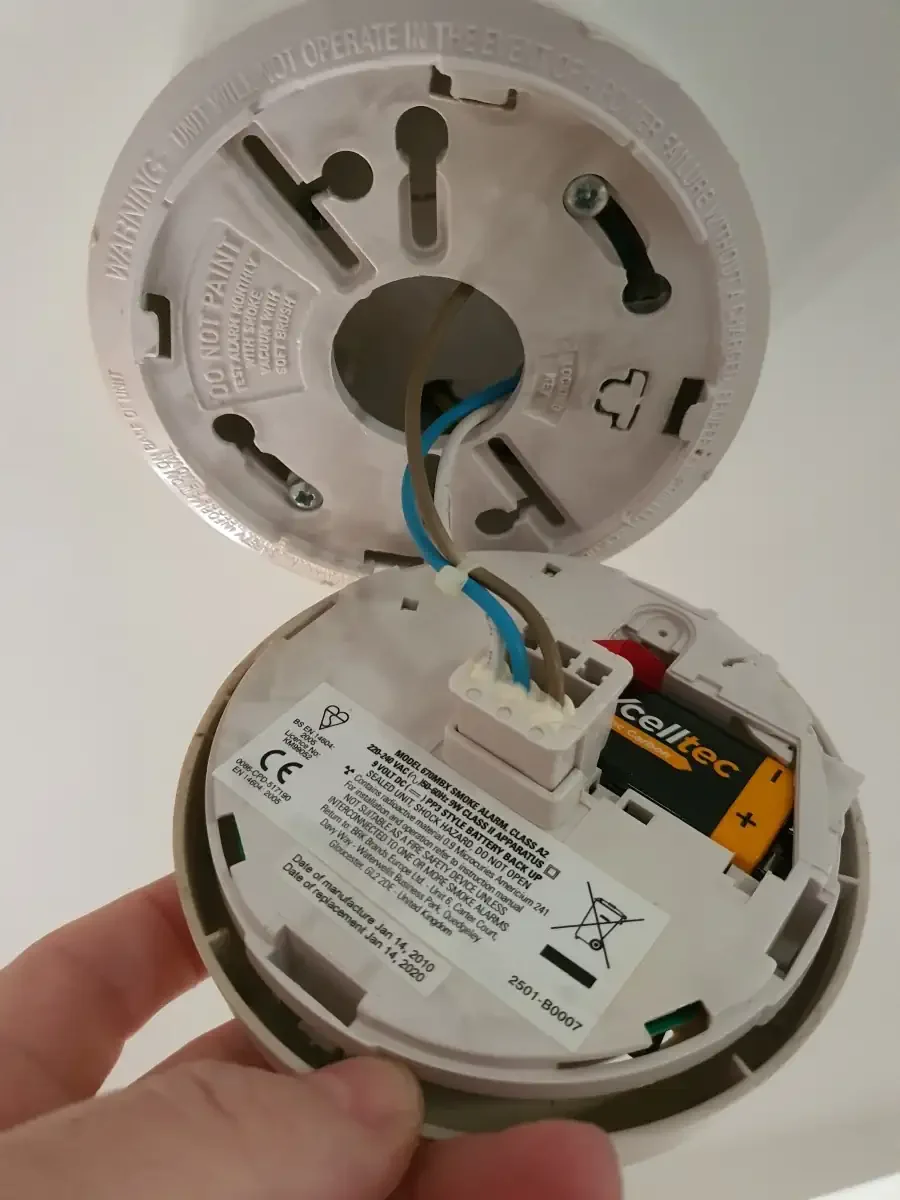
Whether an alarm is mains-powered or battery-operated, it does not last forever.
Smoke and heat alarms have a manufacturer-specified service life and should be replaced when they reach the end of that period.
If the age is unclear, checking the date label or manufacturer information is a sensible first step.
Where Should Smoke & Heat Alarms Be Installed?
The correct alarm position depends on the type of detector, the layout of the property and how the rooms are used.
Good coverage is about more than simply fitting one alarm upstairs and one downstairs. The aim is to place the right type of alarm where it can provide an effective warning without causing unnecessary nuisance activations.
Hallways & Landings
Hallways and landings are common locations for smoke alarms because they often form part of the main escape route through the property.
In multi-storey homes, alarms on each relevant level can help provide warning throughout the building.
Extensions
When a property is extended, the existing alarm arrangement may no longer provide suitable coverage.
A new extension can affect:
Travel distance
Escape routes
Number of rooms
Number of storeys
Existing interlink system
It is worth reviewing the alarm layout whenever major alterations are made.
Near Bedrooms
Alarms should be positioned so that people sleeping in the property can hear them clearly.
That can mean installing smoke alarms in circulation areas near bedrooms, depending on the layout of the home.
Garages & Utility Rooms
Garages and utility areas may need a different type of detector from bedrooms or hallways.
Heat alarms can sometimes be more suitable where dust, fumes or steam would make ordinary smoke alarms prone to nuisance activation.
Avoid Poor Alarm Positions
Alarm performance can be affected by poor positioning.
We consider issues such as:
Corners and dead-air spaces
Ceiling beams
Doors
Windows
Extractor fans
Air vents
Bathrooms
Cooking areas
High or difficult ceilings
The manufacturer’s installation instructions also need to be followed for the specific alarm being fitted.
Every Property Is Different
A small bungalow, three-storey townhouse and converted Victorian property may all need different alarm arrangements.
We look at:
Number of floors
Room layout
Sleeping areas
Kitchens
Escape routes
Existing alarm wiring
Existing detector types
Interlink options
before recommending the final positions.
The best alarm position is the one that gives effective warning for the property layout while using the correct detector type for each area.
Kitchens
Kitchens are usually better suited to heat alarms than standard smoke alarms because cooking fumes and steam can cause nuisance activations.
The exact position should still take account of:
Cooking appliances
Ceiling layout
Doors
Ventilation
Extractor fans
Air movement
Living Rooms
In some properties, additional smoke detection in living areas can improve coverage, especially where the room contains electrical equipment, heating appliances or forms part of the main route through the home.
The need depends on the overall alarm design.
Loft Conversions
Loft conversions can change the fire escape route and increase the number of storeys in the property.
Alarm coverage should be considered as part of the whole house rather than treating the converted room separately.
Replacing Old or Faulty Smoke & Heat Alarms
Smoke and heat alarms do not last forever.
If an alarm is old, damaged, repeatedly false-activating or no longer working correctly, it may need replacing.
Before changing it, we check the existing alarm type, wiring and interlink arrangement so the replacement is suitable for the system already installed.
How Long Do Smoke Alarms Last?
The service life depends on the manufacturer and model.
Many alarms are designed for a fixed operating life, after which the whole unit should be replaced rather than just changing the battery.
The manufacture or replacement date is often shown on the alarm body or label.
Signs an Alarm May Need Replacing
Common warning signs include:
Repeated false alarms
Chirping or fault signals
Failed test button
Yellowing or visible damage
Loose alarm base
Failed backup battery
Interlink no longer working
Alarm beyond its stated service life
A fault signal should not be ignored, especially if several alarms are connected together.
Repeated False Alarms
False activations can be caused by more than a faulty detector.
Possible causes include:
Poor alarm location
Cooking fumes
Steam
Dust
Insects
Contamination
Ageing sensor
Electrical or interlink faults
Moving to a more suitable detector type or position can sometimes solve the problem.
Replacing Mains-Powered Alarms
Where a mains-powered alarm is already installed, replacement can often use the existing wiring if it is in satisfactory condition.
We check:
Supply wiring
Alarm base
Interlink conductor
Backup battery arrangement
Compatibility with the replacement alarm
If the existing system is damaged or unsuitable, we explain what needs attention before fitting the new unit.
Heat Alarm Replacement
Heat alarms also have a limited service life.
If an older kitchen or garage heat alarm is no longer reliable, we can replace it with a compatible unit and test the interlink function where applicable.
Replacing Several Alarms Together
If all alarms were installed at the same time and are reaching the end of their service life, replacing the full set together can make sense.
This helps keep the system consistent and avoids mixing old and new alarm ranges unnecessarily.
Can You Replace Just One Alarm in an Interlinked System?
Yes
The main issue is compatibility.
A replacement alarm must be able to operate correctly with the other units in the system.
Mixing incompatible alarm ranges can cause interlink or fault problems.
Heat Alarm Replacement
Heat alarms also have a limited service life.
If an older kitchen or garage heat alarm is no longer reliable, we can replace it with a compatible unit and test the interlink function where applicable.
Replacing Several Alarms Together
If all alarms were installed at the same time and are reaching the end of their service life, replacing the full set together can make sense.
This helps keep the system consistent and avoids mixing old and new alarm ranges unnecessarily.
Old Alarm Keeps Beeping — Is It Just the Battery?
Sometimes it is, but not always.
Persistent chirping can also indicate:
End-of-life warning
Internal fault
Backup battery problem
Contamination
Connection issue
If a new battery does not solve the problem, the alarm itself may need replacing.
Testing After Replacement
After replacement, the alarms should be tested to confirm:
Individual operation
Interlink function
Backup power where applicable
Secure mounting
Correct fault-free status
Replacing an alarm should not be treated as simply swapping one ceiling unit for another. The wiring, compatibility and interlink system need to work correctly as well.
Smoke Alarm Installation for Landlords & Rental Properties
Landlords have legal responsibilities for smoke and carbon monoxide alarms in rented homes, so the alarm setup should be treated as part of the property’s safety system rather than as an optional extra.
Dan Electrician can install, replace and test smoke and heat alarms for rental properties across Liverpool, Birkenhead and the Wirral.
What Do Landlords Need to Consider?
The exact requirements depend on the property and the type of tenancy, but landlords should make sure the correct alarms are installed and working at the appropriate points in the property.
Important considerations can include:
Smoke alarm coverage
Carbon monoxide alarm requirements
Heat alarms where appropriate
Interlinked alarm systems
Alarm age
Existing wiring
Backup batteries
Testing before or at the start of a tenancy
Replacement of faulty or expired alarms
Smoke Alarms in Rental Properties
Smoke alarms are a basic part of fire safety in rented accommodation.
Their position and quantity should be suitable for the layout of the property and any applicable legal or building requirements.
In larger or multi-storey properties, a more comprehensive alarm arrangement may be appropriate.
Interlinked Alarms for Rental Properties
Interlinked systems can improve warning throughout a property by causing connected alarms to sound together.
This can be useful in:
Multi-storey homes
HMOs
Larger rental properties
Properties with loft conversions
Homes with separated sleeping areas
The exact system should suit the property and any applicable fire-safety requirements.
Heat Alarms in Kitchens
Heat alarms are often better suited to kitchens than standard smoke alarms because they are less likely to react to normal cooking fumes.
Where a rental property has an existing interlinked system, the kitchen heat alarm can often form part of the same network.
Replacing Old Alarms Between Tenancies
A change of tenancy can be a useful time to review the alarm system.
We can check:
Alarm age
Test operation
Battery condition
Interlink function
Physical damage
Previous alterations
Compatibility of replacement units
If several alarms are nearing the end of their service life, replacing them together can help keep the system consistent.
Carbon Monoxide Alarms
Carbon monoxide alarms are a separate safety measure from smoke and heat alarms.
Where required, they should be installed in suitable locations in accordance with the relevant rules and manufacturer instructions.
If a property has fuel-burning appliances, the need for carbon monoxide detection should be considered separately from the fire alarm layout.
Landlord Alarm Faults
Common problems include:
Chirping alarms
Repeated false activations
Failed test buttons
Interlink faults
Damaged bases
Flat backup batteries
Incompatible replacement units
Where the cause is not obvious, the system can be checked before parts are replaced.
Documentation & Records
Landlords should keep clear records of alarm installation, replacement and testing where appropriate.
That can help demonstrate that the property’s alarm system has been maintained and checked.
For rental properties, the safest approach is to treat smoke, heat and carbon monoxide alarms as a complete system and review them whenever the property, tenancy or legal requirements change.
Testing & Certification for Smoke and Heat Alarm Installation
Once smoke and heat alarms are installed or replaced, the system should be checked to confirm that each alarm operates correctly and that any interlink function works as intended.
The exact testing depends on whether the work involves a simple replacement, alteration to existing wiring or installation of a new alarm circuit.
What Is Checked After Installation?
Depending on the system, checks can include:
Correct alarm operation
Test-button function
Interlink operation
Mains supply
Backup battery function
Secure mounting
Correct alarm type for the location
Electrical connections
Circuit protection
Fault indicators
For interlinked systems, one alarm should be able to trigger the others where the system is designed to work that way.
Testing Mains-Powered Alarms
For mains-powered alarms, the electrical supply should also be checked.
This can include confirming:
Correct supply
Polarity
Earthing where applicable
Protective device
Interlink conductor
Backup battery arrangement
If new wiring has been installed, the relevant electrical tests should be completed before the system is put into service.
Testing Interlinked Alarm Systems
Interlink testing is important because an alarm may work individually while the communication between units does not.
We check that:
Each alarm activates correctly
Connected alarms respond
Heat and smoke alarms communicate as intended
Fault indications are clear
Radio-linked units communicate reliably where used
What About New Alarm Wiring?
If new fixed wiring is installed for smoke or heat alarms, the circuit should be inspected and tested in the same careful way as other electrical installation work.
This helps confirm that the system is safe and suitable for continued use.
READ MORE ABOUT REWIRE
A smoke or heat alarm installation is complete only when the alarms, wiring and interlink function have been checked and the appropriate electrical documentation has been provided where required.
Will I Receive an Electrical Certificate?
Where electrical installation work requires certification, the appropriate documentation is provided after satisfactory inspection and testing.
For smaller alterations to an existing circuit, a Minor Electrical Installation Works Certificate may be appropriate.
For a new circuit, an Electrical Installation Certificate would normally be used.
Landlord Records
For rental properties, keeping records of alarm replacement, testing and certification where applicable can be useful.
That may include:
Installation date
Replacement date
Alarm model
Test results
Electrical certificate
Interlink testing
Maintenance history
Does Replacing an Existing Alarm Need a Certificate?
A simple like-for-like alarm replacement does not always involve the same level of certification as new wiring or a new circuit.
However, the replacement should still be checked for correct operation, secure connection and compatibility with the existing system.
Why Testing Matters
The alarm itself is only one part of the system.
A fault can also exist in:
Wiring
Connections
Interlink
Backup supply
Protective device
Compatibility between units
That is why a proper installation should finish with testing rather than simply fitting the alarm and leaving it unverified.
How Much Does Smoke & Heat Alarm Installation Cost?
These are as a general guide:
Replacing an existing alarm — from £80
Installing a new alarm (in addition to the existing system) — from £120
These are starting prices for straightforward jobs where the existing wiring is suitable. The final cost depends on the number of alarms, whether new wiring or interlinking is needed, and how many floors are involved.
What Affects the Price?
The main factors include:
Number of alarms
Smoke, heat or carbon monoxide detection
Mains-powered or battery-powered alarms
Hard-wired or radio interlink
Existing wiring condition
New cable routes
Number of floors
Loft conversions or extensions
Access to ceilings and voids
Replacement of old alarm bases
Electrical testing
Certification where appropriate
Replacing One Existing Alarm
If the existing wiring and base are suitable, replacing one old or faulty alarm can often be relatively simple.
The cost may increase if we find:
Damaged wiring
Incompatible alarm bases
Interlink faults
Failed backup arrangements
Poor previous alterations
It is better to identify those issues before fitting a new alarm onto an unsuitable system.
Replacing Several Alarms
If several alarms were installed at the same time and are all approaching the end of their service life, replacing them together can make sense.
This can help keep the system:
Compatible
Consistent
Easier to test
Easier to maintain
It can also avoid paying for repeated visits to replace individual units one by one.
Heat Alarm Installation Cost
Heat alarms are often installed in kitchens, garages or utility areas.
If a suitable interlinked system already exists, adding or replacing a heat alarm can be straightforward.
If new wiring or system changes are required, the cost will be higher.
Landlord Property Alarm Costs
For landlords, the price depends on:
Property size
Number of floors
Existing alarm system
Alarm age
Interlink requirements
Carbon monoxide alarm requirements
Whether several units need replacement
For larger rental properties, it is usually better to assess the whole alarm system rather than pricing each detector in isolation.new alarm onto an unsuitable system.
The cost of smoke and heat alarm installation depends on the number of alarms, the condition of the existing system and how much new wiring or interlinking is required.
Mains-Powered vs Battery Alarm Cost
Mains-powered systems can involve more labour because electrical wiring may need to be installed or altered.
Battery-powered or radio-interlinked systems can sometimes reduce disruption where new cabling would be difficult.
The best-value option is the one that suits the property properly, not simply the cheapest alarm type.
Clear Quote Before Work Starts
A proper alarm installation quote should make clear what is included.
Depending on the job, this may cover:
Alarm units
Bases
Cable
Labour
Interlink setup
Replacement accessories
Testing
Certification
Fault repairs where agreed
For larger rental properties, it is usually better to assess the whole alarm system.
Smoke & Heat Alarm Installation Across Liverpool, Birkenhead & the Wirral
Dan Electrician provides smoke alarm, heat alarm and interlinked alarm installation across Liverpool, Birkenhead and the wider Wirral.
We work with homeowners, landlords and suitable commercial properties, from straightforward alarm replacement to new multi-alarm systems.
Smoke Alarm Installation in Liverpool
We install and replace alarms across Liverpool for a wide range of residential properties.
Typical work includes:
Smoke alarm replacement
Heat alarm installation
Interlinked alarm systems
Mains-powered alarm upgrades
Radio-linked alarm systems
Faulty alarm replacement
Alarm testing
Landlord property upgrades
Where an existing system is already in place, we assess what can be retained before recommending unnecessary replacement.
Smoke Alarm Installation in Birkenhead
Dan Electrician is based in Birkenhead and provides smoke and heat alarm installation throughout the local area.
We can help with:
Replacing old alarms
Installing new alarm points
Kitchen heat alarms
Mains-powered alarms
Interlinked systems
Fault finding
Landlord alarm upgrades
Testing and certification where applicable
If several alarms are already installed, we can check compatibility and interlink operation before changing individual units.
Alarm Installation for Landlords
For rental properties, we can install and replace suitable smoke, heat and carbon monoxide alarms and check the existing system.
This can be useful:
Before a new tenancy
During refurbishment
After an EICR
When alarms reach end of life
Where interlinking has failed
Where previous alterations have caused faults
Smoke & Heat Alarms Across the Wirral
Coverage extends across the Wirral, including areas such as:
Prenton
Oxton
Bebington
Wallasey
Upton
Bromborough
Heswall
West Kirby
Hoylake
We can help with both individual alarm replacements and larger system upgrades.before changing individual units.
Multi-Storey Homes & Loft Conversions
Properties with several floors can benefit from a properly planned interlinked alarm system.
This is particularly important where sleeping areas are separated from kitchens or other parts of the property.
Renovations & Extensions
If you are renovating or extending a property, it is often a good time to review the alarm system.
Planning alarm locations before ceilings and walls are finished can make the final installation neater and reduce disruption later.
Whether you need one replacement alarm or a complete interlinked system, the installation should suit the property, the existing wiring and the way the building is actually used.
Smoke & Heat Alarm FAQs
-
A smoke alarm is designed to respond to smoke particles, while a heat alarm reacts to a rise in temperature or a set heat threshold.
Smoke alarms are generally used in areas such as hallways, landings and living spaces.
Heat alarms are often more suitable for kitchens and some utility areas where cooking fumes or steam could cause nuisance activation
-
In many homes, yes.
A heat alarm can be more suitable than a standard smoke alarm in a kitchen because it is less likely to react to normal cooking fumes.
The exact arrangement should suit the layout of the property and the wider alarm system.
-
Yes, where the alarms are designed to work together.
This means that if one alarm activates, the connected alarms can sound throughout the property.
Interlinking can be especially useful in multi-storey homes, larger properties and rental accommodation.
-
Yes.
Dan Electrician can install and replace mains-powered smoke and heat alarms across Liverpool, Birkenhead and the Wirral.
Where new wiring is required, the electrical supply and circuit protection are checked as part of the installation.
-
Most mains-powered alarms include some form of backup power.
The exact arrangement depends on the alarm model.
This allows the alarm to continue operating if the mains supply is interrupted.
-
Yes.
Some battery-powered alarms use radio interlinking so several alarms can communicate without hard-wired interlink cabling.
This can be useful in existing properties where running new cables would cause unnecessary disruption.
-
It depends on the manufacturer and model.
Many alarms have a fixed service life and should be replaced when they reach the manufacturer’s stated end-of-life date.
The date can often be found on the alarm body or label.
-
Repeated beeping or chirping can be caused by:
Low or failed backup battery
End-of-life warning
Internal fault
Contamination
Connection problem
If replacing the battery does not solve the issue, the alarm may need further checking or replacement.
-
Possible causes include:
Cooking fumes
Steam
Dust
Poor detector location
Ageing sensor
Insects
Electrical faults
Interlink faults
The alarm should be checked before assuming the unit itself is faulty.
-
Sometimes.
The replacement needs to be compatible with the other alarms already installed.
Mixing incompatible alarm ranges can cause communication or fault problems.
-
Where necessary, yes.
If the existing base is incompatible, damaged or unsuitable for the replacement unit, it may need changing as part of the job.
-
Yes.
We install and replace smoke, heat and carbon monoxide alarms for landlords across Liverpool, Birkenhead and the Wirral.
The exact alarm arrangement depends on the property and the applicable legal requirements.
-
Carbon monoxide alarms are separate from smoke and heat alarms.
Whether they are required depends on the property, tenancy and presence of relevant fuel-burning appliances.
Where needed, they should be positioned in suitable locations and maintained properly.
-
Yes.
Loft conversions can change escape routes and increase the number of storeys in a property, so the alarm arrangement may need to be reviewed as part of the wider fire safety design.
-
Yes.
Renovation is often a good time to install or upgrade alarms because cable routes and alarm positions can be planned before ceilings and walls are fully finished.
-
Yes.
After installation or replacement, the alarms are checked for correct operation.
For interlinked systems, the interlink function should also be tested to confirm that connected alarms sound as intended.
-
Where the work involves electrical installation that requires certification, the appropriate documentation is provided after satisfactory inspection and testing.
The exact certificate depends on the type of work carried out.
-
That depends on the work involved.
A simple alarm replacement is different from installing a completely new electrical circuit.
Where notifiable work is involved, the relevant Building Regulations requirements apply.
-
Yes, where suitable.
Heat alarms may sometimes be more appropriate in these areas depending on the environment.
The detector type should suit the conditions in the room.
-
Yes.
This can include a combination of:
Smoke alarms
Heat alarms
Mains-powered units
Radio-interlinked units
Compatible carbon monoxide alarms where appropriate
The system should be planned around the property layout and existing electrical installation.
-
Call Dan on 07400 238767 or send a quote request.
For a useful initial assessment, send:
Your postcode
Property type
Number of floors
Number of existing alarms
Photos of the alarms if possible
Whether they are mains-powered or battery-operated
Any fault symptoms
Whether the property is owner-occupied or rented
Not sure whether your existing alarm system needs replacing or simply checking? We can assess the setup first and recommend only what is actually required.
Helpful Fire Safety Guides
If you are planning alarm upgrades or trying to understand an existing system, these guides can help with related electrical and fire-safety questions.
Smoke Alarm Replacement
Learn when an older smoke alarm may need replacing, what common fault signals mean and why alarm compatibility matters in an interlinked system.
Faulty alarm can trip RCD, cutting power to part of you property.
Electrical Safety Checks
If your alarms are mains-powered, their wiring forms part of the electrical installation.
For wider electrical safety checks, see:
Heat Alarms for Kitchens
Find out why heat alarms are often better suited to kitchens and how they differ from standard smoke alarms.
Electrical Fault Finding
If an alarm keeps losing power, showing faults or behaving unpredictably, the issue may not always be the detector itself.
Interlinked Smoke & Heat Alarms
Understand how hard-wired and radio-interlinked alarm systems work and why interconnection can improve warning throughout a property.
Need Smoke or Heat Alarms Installed?
Whether you need one replacement alarm or a complete interlinked system, Dan Electrician can assess the existing setup and recommend a practical solution for the property.
We provide smoke and heat alarm installation across Liverpool, Birkenhead and the Wirral for homeowners, landlords and suitable commercial properties.
NICEIC Registered · Fully Insured
30+ Years’ Electrical Experience
Smoke Alarms · Heat Alarms · Interlinked Systems · Testing