

Consumer Unit Replacement: How to Upgrading Your Fuse Box Safely in Liverpool & Wirral
Every single electronic device you rely on—from your smartphone charger and kitchen appliances to high-load EV charging stations and underfloor heating mats—relies on one central point of failure: your home electrical distribution board. Commonly known as a fuse box or consumer unit, this critical component is the literal gateway or "brain" of your property’s power grid.
If your home is still running on an older-style fuse box with wire tracks, your property is likely falling behind modern safety standards, making it highly vulnerable to electrical shocks, device blowouts, and electrical fires.
In this comprehensive local guide, we will break down everything you need to know about a consumer unit replacement. You will discover the crucial signs that your current board is outdated, the cutting-edge safety technology packed inside a modern distribution unit, what the conversion process looks like, and a realistic layout of upgrade costs across Merseyside.
What is a Consumer Unit? (And Why It Matters)
Featured Snippet Definition: A consumer unit (traditionally called a fuse box) is the main control center for a property's electrical supply. Its primary job is to split the main electricity incoming from the grid into individual circuits (like lighting, sockets, and showers) while using integrated safety switches to automatically cut power if an electrical fault, overload, or short circuit is detected.
[Main Grid Supply Input] ──> [Consumer Unit / Main Switch]

         ┌────────────────────────┼────────────────────────┐

[Lighting Circuits]       [Ring Sockets]          [High-Load Appliances]
(Protected by RCBOs)    (Protected by RCBOs)      (EV Charger / Shower)
Older electrical systems utilise standard porcelain blocks wrapped with replaceable copper fuse wire. When a circuit overloads, the thin wire physically melts to cut the current. While this process protects the hardwired cables inside your walls from melting, it lacks the advanced microsecond speed and shock-prevention technology mandated by modern UK electrical safety regulations.
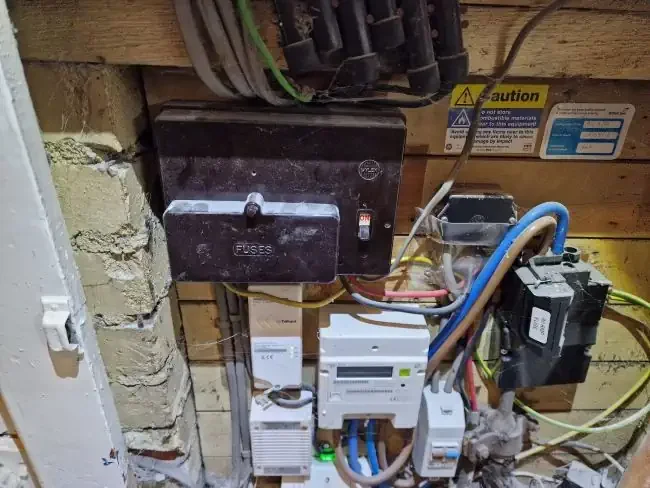
Liverpool home project before rewiring. Old fusboxe and aluminium wiring.
Modern consumer units replace these slow-fusing wires with intelligent, highly precise circuit breakers that instantly flip off when a micro-leak of current is detected, saving human lives from dangerous shocks within milliseconds.
5 Critical Signs Your Property Needs a Fuse Box Upgrade
Many homeowners assume that because their lights turn on and their appliances run, their electrical grid is perfectly safe. However, old distribution components fail silently. If you identify any of the following warning signs in your home, you should immediately contact a certified electrician in Liverpool to review your board's structural integrity.
1. Your Current Fuse Box Has a Wooden Backing or Plastic Casing
If your distribution box is encased in plastic or mounted onto a dark wooden backing board, it is an immediate indicator of a legacy unit. Under strict regulatory standards, all new consumer units installed must be constructed from non-combustible material (such as robust, metal-clad steel). This enclosure standard ensures that if an arc flash occurs inside the board, the fire is completely contained within the sealed steel chassis.
2. There is No RCD Protection Present
Open your consumer panel cover and look for a switch with a prominent button marked "T" or "Test". This button indicates the presence of an RCD (Residual Current Device). If your board only features basic flick switches (MCBs) or old screw-in fuses with zero test buttons, you have zero structural protection against fatal earth faults or electrocution if a cable is accidentally sliced or compromised.
3. Frequent Nuisance Tripping or Blown Fuses
Do your fuses pop or switches drop the exact second you try to run your washing machine and kettle simultaneously? Outdated fuse boards simply weren't designed to handle the heavy, cumulative power demands of modern life. Continuous overload strains the core copper busbars, generating intense internal heat that weakens components over time.
4. Unexplained Flickering Lights or Strange Buzzing Noises
A healthy electrical system should operate in complete silence. If you hear a faint crackling, buzzing, or sizzling noise coming from your meter cupboard, it indicates that current is actively arcing across loose terminal screws or degraded connection joints—a major local fire risk.
5. You are Planning Home Improvements or Subletting
If you are booking a local electrician for a small job like installing garden sockets, adding a new kitchen ring main, or fitting an EV home charger, your existing board must have the modern safety capacity to support it. Tapping new technology into an antique fuse box will instantly violate modern building regulations and void your building insurance cover.
The Technology Inside a Modern Consumer Unit
Upgrading your electrical distribution network replaces old, slow fuses with three layers of automated defence. The table below outlines how modern safety components protect your family and expensive electronic assets:
                       ┌─────────────────────────┐
                       │   incoming mains power  │
                       └────────────┬────────────┘

                       ┌─────────────────────────┐
                       │    Main Switch / SPD    │
                       └────────────┬────────────┘

         ┌──────────────────────────┼──────────────────────────┐

   ┌───────────┐              ┌───────────┐              ┌───────────┐
 │ Kitchen   │              │ Upstairs  │              │ EV        │
   │ Sockets   │              │ Lighting  │              │ Charger   │
   │ [RCBO]    │              │ [RCBO]    │              │ [RCBO]    │
   └───────────┘              └───────────┘              └───────────┘
By ensuring that every individual line in your property has its own dedicated RCBO switch, you eliminate the nightmare of total blackouts. If a kettle develops a fault in the kitchen, only that specific kitchen switch drops. Your internet, downstairs lights, and refrigeration stay perfectly powered.
Click Here to Schedule Your Professional Home Consumer Unit Survey with Dan Electrician Now!
What Does the Replacement Process Involve?
A professional consumer unit replacement is a highly technical, multi-stage engineering procedure that must only ever be executed by a registered, certified installer. Here is exactly what happens when a professional sparky handles your upgrade project:
Step 1: Pre-Installation Visual Safety Survey
Before touching a single live screw, your electrician must carry out a series of targeted visual checks on your incoming meter tails, main earth bonding paths, and water/gas service links to confirm the incoming network can safely take a modern layout.
Step 2: Isolation and Old Board Disconnection
The main supply is safely isolated at the service fuse head. The old plastic or wooden casing is disassembled, and each existing circuit wire is labelled, mapped, and disconnected systematically.
Step 3: Chassis Mounting and First-Fix Looming
The new metal-clad consumer panel is securely anchored to your wall. Main incoming cables are fed into the top entry plates via fire-rated grommets, and the internal copper busbars are loaded with customised RCBO and SPD blocks.
Step 4: Comprehensive Dead-Circuit Testing
This is where real professional skill matters. Your electrician uses calibrated multi-function testers to send precise, safe signals down every wire line in your home. This process checks for structural insulation resistance, short circuits, or hidden neutral faults behind your plasterwork before energising the new components.
Step 5: System Energisation and Live Testing
Power is restored to the board. The electrician tests the physical response speed of your RCDs and RCBOs to ensure they disconnect the power supply within the required millisecond tolerances during an active leakage emergency.
Step 6: Certification and Building Control Sign-Off
Once passed, you are issued a formal Electrical Installation Certificate (EIC). The job is then registered directly with local building control bodies, providing you with the essential paperwork needed if you ever choose to sell or lease your property.
How Much Does a Consumer Unit Replacement Cost in Liverpool & Wirral?
The overall investment required to modernise your electrical distribution core depends on the size of your property, the total number of live circuits needing protection, and whether any existing hidden faults are uncovered during testing.
1-2 Bedroom Property (Up to 6 Circuits): £450 – £650
3-4 Bedroom Family Home (Up to 10 Circuits): £600 – £850
Large Executive Home / Commercial Block (12+ Circuits): £900 – £1,400+
Frequently Asked Questions (FAQs)
How long does it take to replace an old fuse box?
For a standard 3-bedroom family home across Liverpool or Wirral, a professional consumer unit replacement typically takes between 4 and 6 hours of dedicated on-site work. Your electricity will need to be safely switched off for the majority of this duration, so it is highly recommended to plan your day around refrigeration and remote working internet drops.
Can I complete a consumer unit replacement as a DIY project?
Absolutely not. In the UK, replacing a consumer unit is classified as "Notifiable Work" under the strict legal parameters of Part P Building Regulations. Attempting to execute this upgrade yourself without formal testing equipment and credentials is incredibly dangerous, completely illegal, invalidates your property's building insurance policy, and can result in severe prosecution or costly fines when trying to sell your home.
Does a new consumer unit require a full property rewire?
No. Upgrading your consumer unit does not automatically mean you need a full home rewire. In most instances, a modern metal distribution box can be integrated smoothly with your property's existing copper wiring. However, if the initial diagnostic test reveals that your old cables have deteriorated drastically or feature dangerous breakdown characteristics, your electrician will advise on targeted wire repairs before connecting the new board.
Secure Your Home with Dan Electrician Today
Your home's electrical safety should never be left to outdated, 40-year-old switches and ticking component deterioration. Upgrading your consumer core protects your expensive electronics, ensures structural insurance compliance, and grants you ultimate peace of mind that your family is safe from hidden shocks.
Operating straight out of Corfu Street (CH41), Dan Electrician specialises in clean, systematic, and fully certified consumer unit replacements spanning across Birkenhead, the Wirral, and Liverpool. We bring over 28 years of local expertise to every single installation loop, utilising premium components, transparent pricing metrics, and neat workmanship that leaves your home spotless.
Ready to bring your property's electrical grid up to flawless safety standards? Contact Dan Electrician today for a transparent, free, no-obligation quote.
👉 Click Here to Schedule Your Professional Home Consumer Unit Survey with Dan Electrician Now!